Every time and billing platform promises the same thing: track hours, send invoices, get paid. That part is table stakes. The real question is whether the software also tells you which clients, projects, and services are actually making your firm money once real hours are accounted for. That’s where most of these tools quietly stop short, and where the right choice changes how confidently you can run your firm.
Whether you run a boutique consultancy or one of the many accounting firms managing hourly client work, the billing process usually breaks down in the same place: hours get logged in one tool, invoices get built in another, and nobody has a clear picture of billing accuracy until a client questions a line item.
What Is Time and Billing Software?
Time and billing software is a platform that tracks the hours your team spends on client work and turns those hours into invoices. At its most basic, that is the whole job: log time, generate a bill, collect payment.
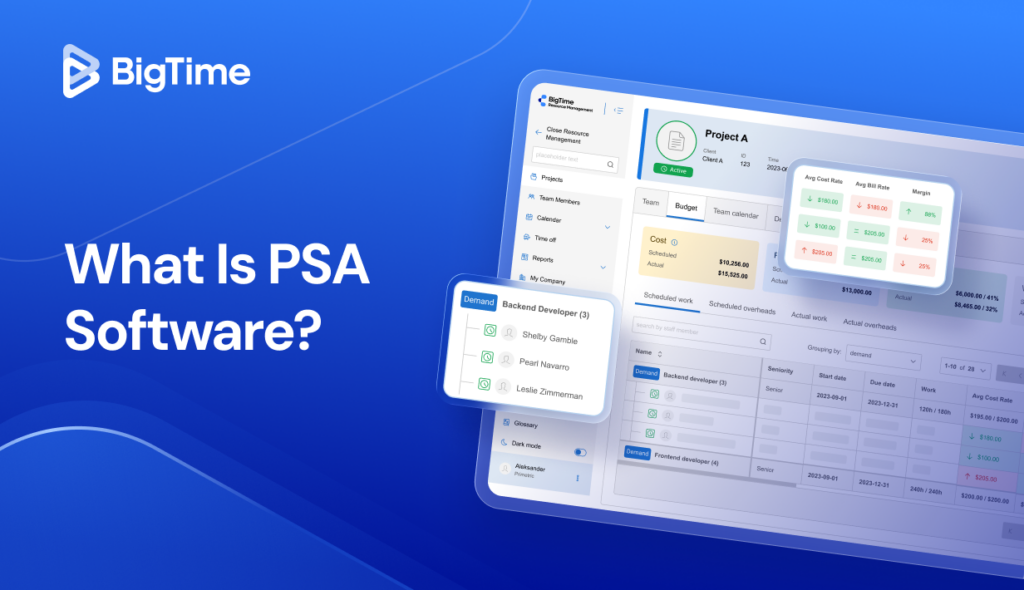
For professional services firms, that basic version leaves a gap. A consulting firm, agency, or accounting practice is not just trying to bill accurately. It needs to know whether the hours going into a project are actually profitable, whether staff are utilized at a healthy rate, and whether pricing holds up once real time is accounted for. That is the difference between a generic time tracker and a platform built for professional services automation (PSA): the PSA layer connects time and billing data to utilization, project margins, and firm-wide financial reporting, not just to an invoicing tool.
Who Uses Time and Billing Software?
Time and billing software shows up across every corner of professional services. Law firms use it to track billable hours against matters and trust accounts. Accounting firms rely on it to bill clients by return, engagement, or retainer. Consultancies and agencies use it to tie time spent on a project back to the budget. What ties these together is the same core need: an accurate, auditable record of time spent that turns into an invoice without a second round of manual entry. At its core, every team just wants to track time once and trust the resulting invoice.
Accounting firms in particular tend to have specific requirements: multiple billing rates per client, compliance-driven audit trails, and tight integration with existing accounting software. That is why software for accounting firms, like Sage Timeslips or TimeSolv, often looks different from a general time tracking solution built for agencies. If you are evaluating accounting time tracking software specifically, narrow your list to platforms built around accounting workflows rather than general time tracking software built for broader project teams.
Common Features to Look For in Time and Billing Software
Beyond the high-level evaluation criteria above, most established platforms share a common core features checklist. Comparing tools feature by feature, rather than by marketing language, makes it much easier to bill clients accurately and avoid missed billable hours later.
Mobile Time Tracking
Staff should be able to get accurate time tracking from a phone with real time tracking and mobile access, not just from a desktop. That matters most for consultants and field staff who bill by the hour but rarely sit at a desk during the day. A mobile app that captures time the moment work happens beats reconstructing a timesheet from memory at the end of the week, and it cuts down on the rounding errors that creep in when hours get logged after the fact.
Task Management and Project Tracking
Task management and project tracking that ties logged hours to a specific task or project phase lets a manager manage projects without leaving the billing tool. Instead of a flat timer running against a client name, time rolls up to the actual deliverable, which makes it far easier to see where a project budget is being spent and to catch scope creep before it erodes a project’s margin. Firms that skip this step often find out a project ran over budget only after the final invoice is sent.
Automated Invoicing and Billing
Automated invoicing and billing create invoices automatically once time entries are approved, cutting down on manual data entry and the manual entry errors that come with re-typing hours into a separate system. The best implementations let a firm review and adjust one draft invoice per client rather than reconciling several exports before anything goes out the door, which shortens the billing cycle from days to hours.
Approving Billable Time
Billable time approvals let a manager review non-billable time and billable time tracking before anything reaches a client, catching missed billable hours before they turn into revenue leakage. An approval step also creates a natural checkpoint for correcting misallocated hours, so a project’s reported margin reflects what actually happened rather than whatever got logged in a rush late on a Friday afternoon.
Advanced Reports and Financial Visibility
Advanced reports and reporting dashboards break down time spent, billing accuracy, and payment history in one place, with complete audit trails for every change. That level of detail matters when a partner or finance lead needs to explain a margin shortfall or defend a rate increase, since the numbers trace back to an actual time entry rather than an end-of-month summary someone assembled by hand.
Online Payments
Online payments support, including the ability to accept credit cards directly on an invoice, shortens the path from an invoice to paid invoices and reduces overdue payments. Clients pay faster when the payment link sits inside the invoice itself instead of requiring a separate login, a mailed check, or a follow-up email from your billing team chasing down a balance.
Transparent Billing
Transparent billing gives clients a clear breakdown of time logs by task, which keeps client communications straightforward and reduces billing disputes. When a client can see exactly which task consumed which hours, a billing question turns into a quick clarification instead of a stalled invoice and a strained relationship. That transparency also makes it easier to justify a rate increase when the time comes.
Room to Grow
Straightforward time tracking works well for solo users, but the better platforms let a basic time tracking workflow grow into a full time tracking solution as a firm scales. That means the same system serving a five-person team on day one can still support fifty people, multiple offices, and more complex billing arrangements a few years later, without forcing a disruptive migration to a different platform mid-growth.
Comparing Time and Billing Software
The table below gives you a quick view of how these eight platforms stack up on price and fit before you read the detailed breakdowns.
| Software | Best For | Starting Price | Rating |
| BigTime | Consultancies and agencies that need utilization and profitability tied to billing | From $20/user/mo | G2: 4.5/5 |
| Harvest | Freelancers and small teams wanting simple time tracking and invoicing | From $11/seat/mo* | G2: 4.3/5 |
| TimeSolv | Law firms and legal billing | From $43.95/user/mo | G2: 4.5/5 |
| Bill4Time | Small legal and consulting practices | From $39/user/mo | G2: 4.7/5 |
| Sage Timeslips | Accounting and CPA firms already on Sage | From $49/user/mo | Capterra: 3.9/5 |
| Productive | Agencies wanting modern budgeting and reporting | From $10/user/mo | G2: 4.6/5 |
| Kantata | Large consulting organizations with complex resourcing | ~$45–50/user/mo** | G2: 4.2/5 |
| Scoro | Agencies wanting CRM and PSA combined | From $26/user/mo*** | G2: 4.5/5 |
Evaluation Criteria
Most comparisons weigh time and billing software against generic criteria: ease of use, integrations, price. Those matter, but they miss what actually separates the platforms on this list for a professional services firm, whether that’s a law firm, an accounting firm, or a growing agency. Before comparing tools, weigh them against these seven factors.
- Billing model flexibility. Can the platform handle hourly, fixed-fee, retainer, and time-and-materials billing without workarounds?
- Utilization tracking. Does it show billable versus non-billable time by person, team, or role, not just total hours logged?
- Profitability visibility. Can you see margin by project, client, or service line, or does it stop at invoicing?
- Time-to-invoice connection. Does tracked time flow directly into an invoice, or does someone need to re-enter it?
- Accounting integrations. Does it sync cleanly with QuickBooks, Xero, or your existing accounting stack?
- Ease of adoption. Will billable staff actually use it consistently, or will time entry become another chore they avoid?
- Scalability. Does pricing and functionality hold up as your firm adds people, or does the model break down past a certain headcount?
Time and Billing Software, Reviewed
1. BigTime
G2: 4.5/5 (1,600+ reviews), Capterra: 4.6/5 (658 reviews)
Pros and Cons
Pros:
- Connects time tracking directly to invoicing, utilization rates, and project profitability reporting in one platform
- Tiered packaging (Essentials, Advanced, Premier, Enterprise) lets firms add functionality as they grow
- Deep integrations with QuickBooks, Salesforce, and other accounting and CRM tools
- Strong customer support ratings from verified reviewers
Cons
- New users can face a learning curve moving past basic time entry into deeper resource and profitability features
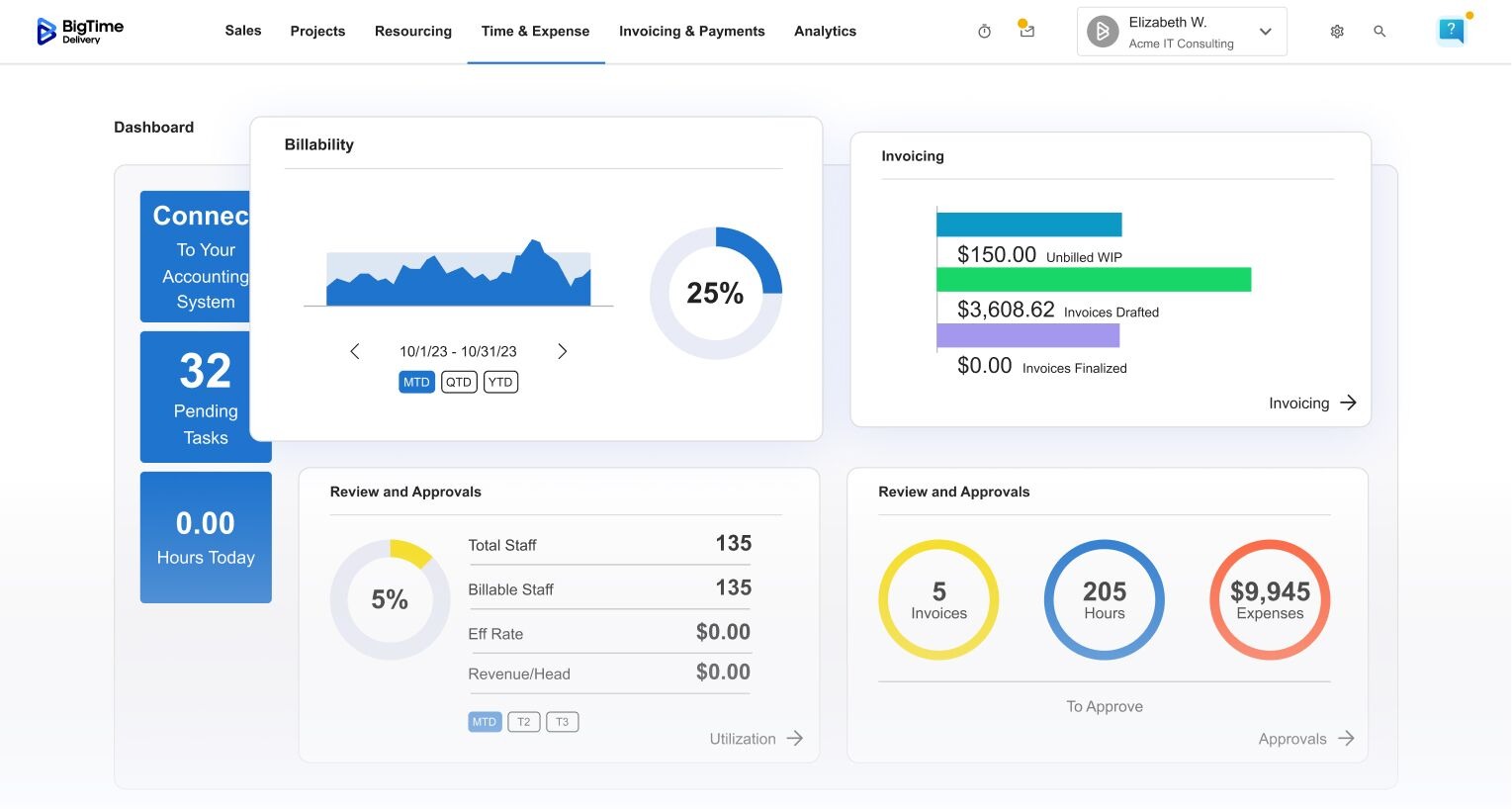
BigTime is a PSA platform built for professional services firms that need more than a timer and an invoice template. It connects time and expense tracking, billing, resource management, and profitability reporting into one workflow, so your team can see not just what was billed, but whether that work protected your margins. That connection between tracked time and firm-wide financial visibility is what separates BigTime from the accounting-specific and freelancer-oriented tools further down this list. It fits firms that bill hourly, fixed-fee, or a mix of both, and that need utilization data to plan staffing decisions rather than just invoicing history.
Key Features
- Time and expense tracking with daily and weekly timesheets for billable and non-billable hours
- Invoice generation supporting fixed-fee, time-and-materials, and hourly billing
- Resource management with utilization tracking by person, team, and role
- Project profitability reporting connected directly to time and billing data
- Integrations with QuickBooks, Salesforce, and other accounting and CRM tools
Pricing
BigTime Essentials starts at $20 per user per month, with Advanced, Premier, and Enterprise tiers adding capabilities like multi-currency invoicing, custom reporting, and full resource allocation as firms grow. A free demo is available.

2. Harvest
G2: 4.3/5 (830+ reviews)
Pros and Cons
Pros:
- Clean, straightforward interface that is easy for small teams to adopt
- Free plan available for a single user
- Wide range of integrations (50-plus) with project management and accounting tools
Cons:
- A 2026 pricing restructuring introduced usage-based fees on top of per-seat pricing, and some larger teams have reported significantly higher renewal costs
- No built-in utilization management or project profitability reporting comparable to a PSA platform
- Forecasting and resource planning are sold as a separate product
Harvest is one of the longest-running dedicated time tracking and invoicing tools, known for a simple interface that small teams and freelancers pick up quickly. It covers the basics of the billing cycle well: track time, log expenses, and convert that into an invoice.
In 2026, Harvest moved to a seat-plus-usage pricing model following an ownership change, and some firms have reported meaningfully higher costs at renewal as a result. For firms that need utilization tracking or profitability reporting alongside billing, Harvest’s feature set stays fairly surface-level compared to PSA platforms built for professional services.
Core Features
- Time tracking via timer, manual entry, or browser and mobile apps
- Expense tracking tied to specific projects and clients
- Invoicing generated directly from tracked time and expenses
- Reporting on team hours and project budgets
- Integrations with over 50 third-party tools, including QuickBooks and Asana
Pricing
Harvest offers a free plan for a single user with two projects. Paid plans start around $11 per seat per month on the Teams tier, with an Enterprise tier at $14 per seat per month. Both paid tiers can carry additional usage-based fees depending on account activity, so firms should confirm total cost before committing.
3. TimeSolv
G2: 4.5/5 (419 reviews)
Pros and Cons
Pros:
- Purpose-built for legal billing, with strong trust accounting support
- Tiered per-user pricing that decreases as firms add seats
- Integrates with QuickBooks, LawPay, and Microsoft 365
Cons:
- Built specifically around legal billing workflows, so firms outside legal or similarly regulated billing get less value from its specialized features
- Limited utilization or firm-wide profitability reporting compared to a full PSA platform
- Some reviewers note a steeper learning curve for customizing bill templates
TimeSolv is a time and billing platform built specifically for law firms and other regulated billing environments. It covers the specifics that legal billing requires, like trust accounting and compliant invoice formats, more thoroughly than general-purpose tools. For firms outside legal services, or those wanting utilization tracking and profitability reporting across a broader professional services operation, TimeSolv’s feature set narrows quickly outside its billing specialty.
Key Features
- Time entry and billing built around legal-specific workflows
- Trust accounting support for client retainer funds
- Customizable invoice and billing statement formats
- Integrations with QuickBooks Online, Microsoft 365, and LawPay
Pricing
TimeSolv starts at $47.50 per user per month for firms with one to four users, with per-user pricing decreasing to $45.12 for five to fourteen users and $42.74 for fifteen or more. A free trial is available. As legal time tracking software, TimeSolv covers trust accounting and compliant billing formats that general time tracking software doesn’t.
4. Bill4Time
G2: 4.7/5 (36 reviews) · Capterra: 4.8/5 (205 reviews)
Pros and Cons
Pros:
- Straightforward setup and daily use, according to reviewers
- Responsive customer support cited consistently in reviews
- Client portal and batch invoicing included
Cons:
- Interface feels dated compared to newer PSA platforms
- Customization and advanced reporting options are more limited for larger or multi-service firms
- G2 review volume is comparatively small, so ratings carry less statistical weight than more widely reviewed platforms
Bill4Time is a cloud-based time and billing platform aimed at lawyers, consultants, and small professional service firms. It handles the core billing cycle cleanly, from time entry through invoicing and payment collection, with a client portal and trust account reporting built in.
Reviewers consistently point to its simplicity and support quality as its strengths. Firms that need deeper resource planning or profitability reporting across multiple service lines will find Bill4Time’s scope narrower than a full PSA platform.
Core Features
- Time entry with daily and weekly summaries
- Batch invoicing and click-to-pay client billing
- Trust account reporting for legal and consulting firms
- Client portal for secure document and invoice access
Pricing
Bill4Time’s Time & Billing plan starts at $39 per user per month, with higher tiers available for firms that need custom reporting or legal practice management features. A free trial is available.
5. Sage Timeslips
Capterra: 3.9/5 (260 reviews)
Pros and Cons
Pros:
- Over 100 pre-built reports for billing and productivity analysis
- Flexible billing arrangements, including multiple rate structures per client
- Deep integration with Sage’s broader accounting products
Cons:
- Reviewers rate ease of use, setup, and customer support notably lower than most other platforms on this list
- Interface and workflow feel dated compared to cloud-native competitors
- No native utilization or profitability reporting beyond billing-focused metrics
Sage Timeslips is a time and billing platform aimed at accounting and CPA firms already using Sage’s accounting products. It leans heavily on its reporting library and flexible billing rate structures, which suit firms that need granular control over client billing arrangements. Still, independent reviewers rate its ease of use and support meaningfully lower than other platforms in this comparison, and the interface has not kept pace with more modern, cloud-native competitors.
Key Features
- Time and expense entry with customizable billing rates
- Invoice and billing statement format wizards
- Over 100 pre-defined reports covering billing and productivity
- Integration with Sage’s accounting product line
Pricing
Sage Timeslips Anywhere starts at $49 per month for the first user, with additional users priced separately. A free trial is available.
6. Productive
G2: 4.6/5 (63+ reviews)
Pros and Cons
- ✓ Modern interface with strong recurring-budget and retainer management features
- ✓ Combines time tracking, invoicing, resource planning, and reporting in one platform
- ✓ Well-suited to agencies managing multiple concurrent client budgets
- ✗ Some reviewers note reporting customization is less flexible than they would like
- ✗ Financial forecasting and advanced customization are reserved for higher-tier plans
- ✗ Less depth on enterprise-grade financial controls compared to platforms built for larger, multi-entity firms
Productive is a PSA platform built for agencies and consultancies, combining time tracking, budgeting, invoicing, and resource planning in one workspace. It is particularly strong on recurring budgets and retainer management, which makes it a good fit for agencies billing monthly retainers alongside project work. Unfortunately, firms with more complex financial structures, multiple entities, or deeper forecasting needs may find Productive’s reporting less customizable than they need without moving to its highest tier.
Core Features
- Time tracking via timer, calendar sync, or manual entry
- Automated invoicing with support for multi-currency and multi-entity billing
- Project budgeting tools for fixed-price and retainer-based projects
- Resource planning with capacity and workload views
- Reporting library with over 50 templates
Pricing
Productive’s Essential plan starts at $10 per user per month, with the Professional plan at $25 per user per month. The Ultimate plan is priced on request.
7. Kantata
G2: 4.2/5
Pros and Cons
Pros:
- Deep resource and portfolio planning for large, complex consulting organizations
- Choice of Salesforce-native or open infrastructure deployment
- Extensive library of prebuilt integrations (1,200-plus, including Salesforce, NetSuite, and Sage Intacct)
Cons:
- Pricing is quote-based and not published; third-party estimates place entry cost around $45 to $50 per user per month, often with a seat minimum that can price out smaller firms
- Reviewers describe a steeper learning curve and heavier day-to-day navigation than lighter PSA platforms
- Configuration and reporting logic often require a dedicated administrator
Kantata (formerly Mavenlink) is an enterprise-grade PSA platform aimed at large consulting organizations and agencies with complex resourcing needs. It goes deeper on resource and portfolio planning than most platforms on this list, with the option to run natively on Salesforce or on its own open infrastructure.
That depth comes with a tradeoff: pricing is custom and quote-based, and several independent sources report seat minimums that make Kantata a difficult fit for firms under roughly 50 people. For large organizations that need sophisticated resource forecasting across many concurrent projects, Kantata remains one of the most capable options in the category.
Key Features
- Resource management with skills-based staffing and capacity forecasting
- Project accounting covering budgets, margins, and real-time financial visibility
- Choice of Salesforce-native (Kantata SX) or open infrastructure deployment
- Over 1,200 prebuilt integrations, including Salesforce, NetSuite, and Sage Intacct
Pricing
Kantata does not publish standard pricing. Third-party estimates place entry pricing around $45 to $50 per user per month, typically with a seat minimum; firms should request a custom quote to confirm actual cost.
8. Scoro
G2: 4.5/5 (486 reviews)
Pros and Cons
Pros:
- Combines CRM, project management, time tracking, and billing in a single hub
- Strong QuickBooks and Xero sync for financial reporting
- High reviewer satisfaction once onboarding is complete (77 percent five-star on G2)
Cons:
- Every plan requires a 5-seat minimum, which raises the effective entry cost well above the advertised per-user rate
- Steeper learning curve during setup, according to reviewers
- Mobile app functionality lags behind the desktop experience
Scoro is an all-in-one professional services automation platform that combines CRM, project management, time tracking, billing, and financial reporting. It is built for agencies and consultancies that want to consolidate several tools into one operational hub, and reviewers consistently praise its reporting depth and accounting integrations once teams get past the initial setup. The catch is packaging: every plan carries a 5-seat minimum, so the advertised starting price understates what a small team will actually pay.
Core Features
- CRM with quoting and sales pipeline tracking
- Time tracking tied directly to projects and billing
- Financial reporting and project revenue models by contract type
- Native integrations with QuickBooks and Xero
Pricing
Scoro’s Essential plan starts at $26 per user per month on annual billing, with Standard at $37 and Pro at $63. Every plan requires a minimum of five seats, and an Ultimate tier is available on request.
Benefits of Time and Billing Software
Managing billing across a growing team is one of the reasons firms move off spreadsheets and adopt dedicated billing tools. The right billing solution should make it possible to manage billing for multiple entities or currencies without hiring another admin, while still giving each team member clear visibility into their own utilization.
Still, that’s just one of the benefits of the right time and billing software. Others include:
- Faster, more accurate invoicing. Time flows directly into an invoice instead of being re-entered by hand, cutting down on billing errors and delays.
- Improved utilization visibility. Firms can see billable versus non-billable time by person or team, not just aggregate hours.
- Better cash flow. Faster billing cycles and fewer write-downs mean revenue reaches the firm sooner.
- Clearer project profitability. Connecting time and billing data to project margins shows which engagements are actually worth the effort.
- Reduced administrative burden. Billable staff spend less time on manual time entry and invoice preparation, and more time on client work.
- Consistent time capture. The fastest way to track time consistently is to make logging as close to the work as possible, inside the project, not in a separate spreadsheet.
- One system of record. Whether your team tracks time on a desktop or a phone, the goal is the same: track time once, and let the software handle billing, reporting, and payment history from there.
Choosing the Right Fit
Choosing time and billing software comes down to how far past the invoice you need visibility to go. A straightforward tracker like Harvest or Bill4Time covers the basics well for a small team billing simply, but most firms outgrow that the moment they’re juggling more than one billing model or trying to understand which projects actually protect their margins. That’s exactly where BigTime stands apart: it’s the only platform in this comparison built specifically to connect time tracking, billing, utilization, and project profitability in one workflow, rather than treating billing as a standalone task bolted onto a generic timer. For firms that have outgrown a basic tracker, BigTime is the strongest fit on this list.
Ultimately, a good time tracking and billing setup should feel invisible to your billable staff and visible to your finance team, and that’s exactly the balance BigTime strikes. Your team logs time the way it always has, while your finance team gets real time visibility into project margins and utilization without assembling a separate report. Whatever you choose, confirm the core features that matter most: how the platform handles your billing process, whether it can generate accurate invoices without manual entry, and whether it gives you that same visibility into project margins. BigTime checks all three boxes, which is why it’s the platform we’d point most professional services firms toward first.
Frequently Asked Questions
What’s the difference between time tracking software and time and billing software?
Time tracking software logs hours worked. Time and billing software takes that same data and turns it directly into client invoices, often with additional reporting on utilization and profitability. Either way, the goal is to track time in one place rather than duplicating entries across tools.
How much does time and billing software cost?
Pricing ranges widely, from roughly $10 per user per month for lightweight tools to $50 or more per user per month for platforms with deeper resource management and enterprise reporting. Seat minimums and usage-based fees can raise the real cost beyond the advertised rate, so it’s worth confirming total cost before committing.
Can time and billing software integrate with QuickBooks or Xero?
Most established platforms, including BigTime, Harvest, TimeSolv, and Scoro, integrate directly with QuickBooks or Xero to sync invoices and financial data automatically.
Is time and billing software worth it for a small firm or solo practitioner?
Yes, though the right tool depends on complexity. A solo practitioner billing hourly may only need a simple tracker, while a small firm managing multiple billing models and client engagements benefits from a platform with stronger reporting.
What’s the difference between a PSA platform and standalone billing software?
Standalone billing software focuses on the time-to-invoice workflow. A PSA, or professional services automation, platform connects that same billing data to resource management, utilization tracking, and firm-wide profitability reporting.
Does time and billing software help with profitability, not just invoicing?
It can, but not all platforms go that far. Tools built specifically for professional services automation, like BigTime, connect tracked time and billing data to project and firm-wide margin reporting, while simpler time trackers typically stop at the invoice.
Do accounting firms need different time and billing software than agencies?
Often, yes. Accounting firms typically need tighter integration with existing accounting platforms and accounting software, along with support for multiple billing rates per client. Agencies and consultancies lean more on project management tools and utilization reporting across a team.
Can time and billing software help with legal time tracking specifically?
Yes. Platforms like TimeSolv and Bill4Time were built around legal time tracking and trust accounting requirements, which general time tracking software usually doesn’t cover in the same depth.
What features help a team stay on top of billable hours consistently?
Look for mobile time tracking, billable time approvals, and complete audit trails, so managers can track time accurately and catch missed billable hours before an invoice goes out.
How does time and billing software help accept credit cards and online payments?
Most platforms let clients pay directly from an invoice using online payments or by card, which shortens the time between a paid invoice and improved cash flow, and cuts down on overdue payments.
Is a free plan enough for a solo practitioner who just needs to track time and bill clients?
A free plan can work for basic time tracking and simple invoicing, but most solo practitioners outgrow it once they need automated billing, advanced reports, or integration with accounting software.