Most time tracking and invoicing software promises the same thing: log hours, send invoices, get paid faster. But professional services firms need more than a stopwatch bolted onto an invoice template. You need to see which projects are actually profitable, which team members are hitting utilization targets, and whether your billable rates still make sense. Here’s how the top options stack up, and what actually matters when hours logged need to turn into revenue collected.
What Is Time Tracking and Invoicing Software
Time tracking and invoicing software sits between a basic stopwatch app and a full accounting suite. It logs the hours your team spends on client work, then turns those hours into invoices without you rebuilding the record in a spreadsheet.
That’s different from a plain timer, which stops at hours logged and leaves billing to someone else. It’s also different from full accounting platforms, which handle invoicing but weren’t built to capture billable time at the task level in the first place.
For professional services firms, this middle layer matters. When timesheet and invoicing software is disconnected from actual client billing, hours go untracked, rates go stale, and margins erode quietly on projects that looked profitable on paper. And not every platform in this space is built the same way: time tracking features that look identical in a screenshot can behave very differently once billing, approvals, and reporting all depend on the same data.
Key Features in Time Tracking and Invoicing Software
Not every invoice and time tracking software platform treats these features the same way. Here’s what separates a basic timer from a tool built to support client billing.
Automated Time Tracking
Timers, calendar-based auto-capture, and idle detection form the baseline. The goal is accurate hours logged with minimal manual entry, so nothing gets reconstructed from memory at the end of the week. Most platforms also support desktop and mobile apps, so tracking stays consistent whether someone’s at a desk, on a job site, or moving between client meetings. Firms that track time this way rarely lose billable hours to memory gaps once the invoice period closes.
Billable Rate Management
Rates set per project, per task, or per person let a firm bill accurately across a mix of engagements, and separate billable time from internal or non-billable work at the entry level rather than after the fact. The stronger implementations also let rates change mid-project without disrupting time already logged, which matters for firms that renegotiate scope or bring on new team members partway through an engagement.
Invoice Generation
Approved, tracked hours should flow directly into a client-ready invoice. This is the feature that separates true time tracking and invoicing software from a timer that simply exports a spreadsheet for someone else to bill from. Look for support for both time-and-materials and fixed-fee billing, since most professional services firms run a mix of both across their client base, and the invoice format should be flexible enough to group entries by project, task, or team member depending on what a client expects to see.
Approval Workflows
Locking time after a manager reviews it keeps unapproved or duplicate entries from ever reaching a client invoice. It’s a quiet feature, but it’s often the difference between clean billing and a disputed invoice. Multi-level approval, where a project lead and a billing manager both sign off before time is locked, adds an extra layer of protection for firms billing high-value or long-running engagements.
Utilization and Profitability Reporting
This is the layer most generic tools skip. Reporting that shows billable utilization rates by person and margin by project turns time tracking from a payroll exercise into a real view of business performance. The most useful versions let a firm compare estimated hours against actual hours in real time, so margin erosion shows up while a project is still active rather than after it closes and the damage is already done.
Integrations
Connections to accounting platforms like QuickBooks and Xero, along with project and communication tools, keep time data from sitting in a silo separate from the rest of the firm’s financial records. An open API matters too, for firms that eventually need to connect time and billing data to a CRM or a custom reporting stack rather than relying only on the integrations a vendor ships out of the box.
How Firms Use Time Tracking and Invoicing Software Day to Day
Tracking Time Day to Day
A typical week looks similar across most firms evaluating billing software: someone opens a mobile app to track time between client meetings, a lead checks project progress against budget, and finance runs reports before invoices go out. The best platforms make each of those steps fast enough that people actually do them, instead of reconstructing a week of work hours from memory on a Friday afternoon.
Day to day, a handful of time tracking features get used constantly: a timer for active work, manual entry for time logged after the fact, and task management that ties each entry to a specific project or client. Team members clock time against tasks rather than vague buckets, so tracked hours roll up into something a manager can act on. Track time consistently enough, across enough people, and the numbers start to show where team productivity is genuinely strong and where it isn’t.
Turning Hours Into Invoices
On the billing side, the goal is the same whether a firm bills a handful of retainer clients or dozens of project-based engagements: create invoices directly from approved time, with none of the manual re-entry that introduces errors. Firms that generate accurate invoices this way spend less time chasing down discrepancies and more time on the work itself.
Recurring invoices matter here too. A firm running monthly retainers wants that billing process to run itself once the setup is done, rather than rebuilding the same invoice from scratch every month. Getting this right is what lets a firm bill clients correctly the first time, instead of issuing a corrected invoice a week later. It also helps to track billable hours precisely enough to bill for every billable hour without a client questioning the total.
Reporting That Actually Gets Used
Project reporting is where the difference between a basic timer and something more capable shows up fastest. Detailed reports on utilization and margin let a manager gain insights that a spreadsheet never surfaces cleanly, and real time insights on an active project catch problems while there’s still time to fix them.
Not every tool offers the same reporting capabilities. Some stop at a simple hours-by-project export, while others support customizable reports, advanced reporting on trends across a client portfolio, and detailed reporting built for the specific questions a firm actually asks. Firms that lean on this kind of project reporting tend to make more data driven decisions about staffing and pricing, and reviewers across the category consistently cite that reporting depth as one of the more valuable insights a platform can offer.
Where Project Management Overlaps
Time tracking rarely lives in isolation from project management. The stronger platforms in this category borrow ideas from dedicated project management tools: project templates that speed up setup for repeat engagement types, project dependencies that show what’s blocking what, and the ability to assign tasks to specific team members with a deadline attached.
None of this replaces a full project management tool for firms with complex delivery workflows, but it’s usually enough for firms managing projects around client billing rather than product development. Project planning benefits too, since a lead scheduling next month’s work can see actual velocity from tracked hours rather than guessing. Task tracking tied to project time gives a manager a single place to see whether a team is on pace to complete projects on budget, instead of checking three different tools to piece the picture together.
Integrations, Mobile Access, and Interface
Integration features matter more than they might seem at first glance. Integrated time tracking that connects to the accounting tools a firm already uses, most commonly QuickBooks or Xero, means billing data doesn’t have to be rebuilt in a second system, and a handful of platforms in this category handle that connection well enough that finance barely notices the handoff.
Access matters too: mobile access for people working from a client site, plus a version that works as well on a desktop computer as it does on a phone. A user friendly interface and an intuitive interface aren’t quite the same thing — the first is about how a product looks, the second about whether a new hire can track work correctly on day one without training. Firms also use these platforms to attach receipts to expenses, keep a record of a team’s time split between internal work and non billable time, and layer in activity tracking for firms that want a closer view of where the day actually goes.
Scaling From Simple to Sophisticated
Not every firm needs sophisticated time tracking on day one. A two-person consultancy just starting to formalize how it bills clients might only need to track time employees spend on a handful of specific tasks, using one of the simpler time tracking tools in this category rather than a full PSA platform.
Team collaboration tends to matter more as a firm grows past that stage, when several people need visibility into the same client’s hours without stepping on each other’s entries. Firms in this position often start with a free plan or a low-cost tier and upgrade once billing volume justifies it — a path that works fine for small businesses with a handful of clients, less well for a firm trying to track billable hours across a dozen active engagements. At that point, the goal shifts from simply logging time to using billing software that ties tracking, approvals, and invoicing together, one of the more direct ways a firm can boost productivity without adding headcount.
Benefits of Time Tracking and Invoicing Software
The right platform gives your team real-time visibility into where time is going and how that time turns into revenue, so decisions get made on current numbers instead of last month’s spreadsheet. Firms that track time consistently and tie it to billable hours tend to see the payoff most clearly at invoice time, when the numbers on the bill already match the work that was actually done.
- Fewer billing disputes, since invoices trace back to approved, itemized time entries.
- Faster invoicing cycles, with less manual work rebuilding records from timesheets.
- Clear utilization data by person, project, and team, supporting better forecasting.
- Improved project profitability, since margin issues surface while a project is still active, not after it closes.
- Cleaner client relationships, backed by transparent, accurate billing.
- Stronger team productivity, since managers can see workload and billable hours by person instead of guessing at capacity.
- More time spent on billable work and less on administrative cleanup, once billing software handles reconciliation automatically.
- Faster movement from tracked work hours to a finished bill, with fewer manual steps needed to create invoices.
Evaluation Criteria for Professional Services Firms
When comparing invoicing and time tracking software, generic criteria like task management or reminders matter less than the criteria below. These are weighted toward what actually affects a professional services firm’s bottom line. Firms that already track time consistently tend to know which of these criteria matter most to their own billing pattern before they ever open a pricing page, since the choice of billing software really comes down to which gaps in that existing process need to close.
- Billing-data connection — do tracked hours flow to invoices without re-entry?
- Utilization visibility — clear billable versus non-billable reporting, with targets.
- Profitability reporting — project and client margin visibility, not just hours logged.
- Rate flexibility — per-project, per-task, or per-person billable rates.
- Approval workflow — locking and approving time before it reaches an invoice.
- Integrations — accounting platforms and the project tools your team already uses.
- Ease of adoption and pricing transparency — a tool your team will actually use consistently.
Comparing the Best Time Tracking Invoicing Software Options
A side-by-side view of where each tool fits, based on G2 ratings and current published pricing.
| Tool | Best For | G2 Rating | Starting Price | Profitability Reporting |
| BigTime | Professional services firms | 4.5/5 (1,873 reviews) | $20/user/mo | Yes — built in |
| Harvest | Simple time tracking & invoicing | 4.3/5 (870 reviews) | Free; $11/seat/mo | Premium tier only |
| Clockify | Free time tracking | 4.5/5 (200+ reviews) | Free; $3.99/user/mo | Limited |
| FreshBooks | Invoicing-first workflows | 4.5/5 (975 reviews) | $23/mo (5 clients) | Limited |
| Everhour | Project-management integration | 4.7/5 (179 reviews) | Free; $8.50/user/mo | Yes — project-level |
| TimeCamp | Budget-friendly growth | 4.7/5 (354 reviews) | Free; $3.99/user/mo | Limited |
| Productive | All-in-one agency platform | 4.6/5 (63 reviews) | $10/user/mo | Yes — built in |
1. BigTime
G2 Rating: 4.5/5 (1,873 reviews)
Pros and Cons
Pros
- Built specifically for professional services billing workflows
- Ties time entries directly to project budgets and profitability reporting
- Strong QuickBooks integration
- Resource management and utilization reporting live in the same platform
Cons
- Reporting customization has a learning curve for some new users
- Pricing sits above budget-tier tools like Clockify or TimeCamp
- Mobile app is more limited than the desktop experience, per some reviewers
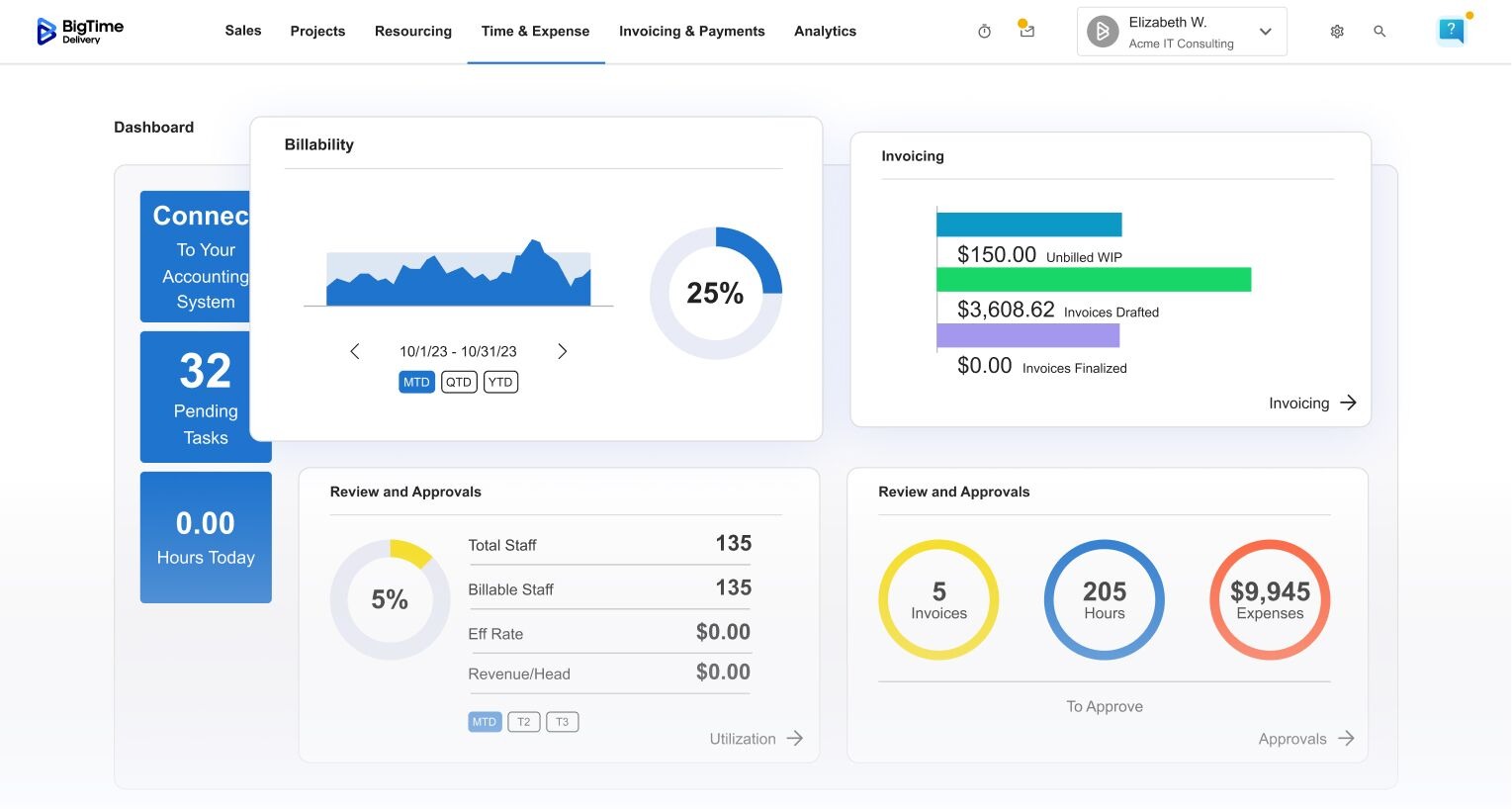
BigTime is a PSA platform built around the way professional services firms actually bill clients, with time tracking, project budgeting, invoicing, and profitability reporting connected in one place rather than stitched together from separate tools. Hours logged against a project flow directly into invoices, while managers get a live view of utilization and margin before a project runs over budget. G2 reviewers consistently point to the direct line from time entry to financial reporting as the reason it fits firms where billing accuracy affects revenue every week, not just at invoice time.
Setup is guided rather than left to chance: firms moving off spreadsheets or a lighter tool get hands-on support configuring rate cards, budgets, and report templates around how their business actually runs, and that upfront configuration is exactly what makes the platform this capable once it’s live. From there, reporting, billing, and time tracking all pull from the same data, which is why reviewers consistently point to BigTime as the strongest fit for firms that depend on billing accuracy every week.
Key Features
- Project-level budgeting tied directly to time entries, so overruns surface before a project closes rather than after
- Automated invoice generation with fixed-fee and time-and-materials support, built around how professional services contracts are actually structured
- Profitability and utilization reporting by project, client, and team member, with real-time comparisons against original estimates
- QuickBooks, Salesforce, and Slack integrations that keep billing, CRM, and team communication in sync
- Resource management for allocating team capacity across active and upcoming projects
- Mobile time entry for teams working on-site with clients
Pricing
Starting around $20 per user per month, scaling to about $45 per user per month depending on plan, according to G2 pricing data. There’s no permanent free plan, but a free trial is available.
2. Harvest
G2 Rating: 4.3/5 (870 reviews)
Pros and Cons
Pros
- Straightforward interface, widely praised for ease of use
- Free tier covers two projects, useful for evaluating fit
- Solid QuickBooks and Xero integrations
Cons
- Mid-2025 acquisition introduced usage-based fees on top of per-seat pricing
- Multiple G2 reviewers report renewal costs rising well beyond their original quote
- Profitability reporting limited to the top-tier plan
- No native resource or capacity planning
Harvest remains one of the more recognizable names in time tracking and invoice software, and simplicity is still its strongest selling point: start a timer, log time, generate an invoice. That simplicity comes at a cost, though, once a firm needs more than the basics.
After a 2025 acquisition, Harvest moved from flat per-seat pricing to a base rate plus usage fees for invoices, projects, clients, and tasks, and G2 reviewers have documented renewal increases running into the thousands of dollars for growing teams that didn’t see the change coming. Profitability reporting, one of the more useful features for a professional services firm, is locked behind the Premium plan, and even then it’s a narrower view than what dedicated PSA platforms provide. Firms that outgrow simple project-based billing tend to find Harvest’s reporting and resource planning thin, and should request a detailed usage-fee quote before committing beyond a small team.
Key Features
- Timer and manual time entry, with support for tracking time against individual tasks and projects
- Expense tracking alongside logged time, including receipt attachments
- Client invoicing with online payment collection through Stripe and PayPal
- Team and project reporting that breaks down hours by client, project, and task
- Integrations with more than 50 third-party apps, including Asana, Trello, and Slack
Pricing
Free for up to two projects. The Pro plan starts at $11 per seat per month (annual billing); Premium, which adds profitability reporting, runs $14 per seat per month, plus usage-based fees that Harvest does not publish and that vary by account activity.
3. Clockify
G2 Rating: 4.5/5 (200+ reviews)
Pros and Cons
Pros
- Most generous free plan in the category, with unlimited users and projects at no cost
- Paid tiers stay inexpensive
- Simple, quick setup for teams moving off spreadsheets
Cons
- Invoicing and billable-rate features require a paid plan
- Profitability reporting is thinner than PSA-focused competitors
- Some reviewers note mobile sync issues
- Not built with professional services billing workflows in mind
Clockify’s free tier is the reason it shows up on nearly every time tracking invoicing software shortlist: unlimited users and projects with no time limit, which is rare in this category.
That generosity is mostly limited to raw time logging, though. Billing features unlock only at higher tiers — Standard adds billable rates and budgets, and Pro adds invoicing — so a firm evaluating Clockify on the no-cost tier alone is really only testing the timer, not the invoicing workflow it will eventually need. Profitability and utilization reporting stay basic even on paid tiers compared to platforms built specifically for billing professional services work, and some reviewers report sync issues between the mobile and desktop apps that can leave time entries inconsistent across devices.
For a firm whose main need is dependable timesheet and invoicing software without per-seat cost pressure on a growing team, Clockify is worth testing, but it functions more as a starting point than a long-term billing system for most professional services firms.
Key Features
- Timer, manual entry, and timesheet views, with calendar-based visualization of logged hours
- Billable and non-billable rate tracking, available from the Standard tier up
- Invoicing generated directly from tracked time, available from the Pro tier up
- Kiosk mode for shared-device clock-in across a physical location
- GPS location tracking for field-based teams, available on Pro and higher plans
Pricing
Free for unlimited users and projects. Paid tiers start at $3.99 per user per month, scaling to $11.99 per user per month for Enterprise, per G2 and vendor pricing data.
4. FreshBooks
G2 Rating: 4.5/5 (975 reviews)
Pros and Cons
Pros
- Invoicing and payment collection are the strongest part of the product
- Simple setup for solo operators and small teams
- Client and project collaboration built in
Cons
- Plans cap the number of billable clients rather than users
- Time tracking exists mainly to feed invoices, not to report on utilization
- No project profitability or resource management features
- Pricing has increased more than once in the past year, per user reports
FreshBooks approaches this category from the invoicing side first, with time tracking as a feature that feeds the invoice rather than the center of the product. That works well for firms whose main need is getting paid quickly rather than analyzing utilization across a project portfolio, but it also means the platform has real limits for a firm trying to manage billable hours as a business metric rather than a billing input.
The client-count pricing model is particularly worth flagging: plans are capped by billable clients rather than by users, so a firm can hit the cap and get pushed into a pricier tier well before it actually needs more seats. Reviewers have also noted repeated list-price increases over the past year, and profitability or resource-planning features simply don’t exist here the way they do in PSA-focused tools. FreshBooks fits firms that want fast, simple invoicing more than firms trying to manage utilization and project margins.
Key Features
- Time tracking synced directly to invoices, so logged hours appear on a client bill without re-entry
- Chrome browser timer and a mobile app for tracking time away from a desktop
- Client and project collaboration, including shared files and comments
- Expense tracking bundled into higher tiers
- Double-entry accounting and financial reporting on Plus and Premium plans
Pricing
Plans start around $23 per month for the Lite tier (five clients), scaling to $70 per month for Premium (unlimited clients), per current list pricing. Promotional discounts are frequently available.
5. Everhour
G2 Rating: 4.7/5 (179 reviews)
Pros and Cons
Pros
- Time tracking embeds directly inside Asana, Trello, ClickUp, and Jira
- Strong approval and budget-alert workflow
- Straightforward, transparent single-tier pricing
Cons
- Five-seat minimum on the paid Team plan raises effective per-seat cost for smaller teams
- No native project management of its own
- Reporting quality depends heavily on the data in the connected PM tool
- Limited standalone functionality for firms not already using a supported PM platform
Everhour’s differentiator is where it lives: inside the project management tools teams already use, rather than as a separate destination. That in-context tracking, paired with real-time budget alerts and an approval workflow before time reaches an invoice, makes it a strong fit for firms whose work already runs through Asana or ClickUp.
The dependency cuts both ways, though. Everhour has no project management of its own, so its usefulness rises or falls with the quality of the tool it’s embedded in, and firms not already using one of its supported integrations get a noticeably thinner experience. The five-seat minimum on the Team plan is also worth budgeting around: a three-person firm pays for five seats regardless, which pushes the effective per-user cost above the advertised rate. It’s a solid choice for teams that have already standardized on a supported PM tool, and a weaker one for firms evaluating time tracking as a standalone billing system.
Key Features
- In-app time tracking inside Asana, ClickUp, Trello, and Jira, so team members never leave the board they’re already working in
- Project budgets with real-time alerts before spend crosses a set threshold
- Invoice generation with QuickBooks and Xero export
- Approval and time-lock controls that protect billed periods from later edits
- Browser extension that adds a timer directly to supported apps without switching tabs
Pricing
Free for up to five users with limited features. The Team plan starts at $8.50 per user per month (annual billing, five-seat minimum), per Capterra and G2 pricing data.
6. TimeCamp
G2 Rating: 4.7/5 (354 reviews)
Pros and Cons
Pros
- Free plan includes unlimited users and projects
- Paid tiers stay inexpensive
- Automatic time tracking captures app and website use in the background
Cons
- Billing and invoicing features are limited on the entry-level Starter plan
- Some reviewers report inconsistent customer support response times
- Profitability reporting is not a core strength
- Reporting filters feel restrictive once billing needs get more specific, per reviewers
TimeCamp pairs a genuinely useful no-cost tier with automatic tracking that fills in timesheets from background activity rather than relying on employees to remember to start a timer, and for freelancers or very small teams that alone can be worth the switch.
Once a firm needs more than basic hours-to-invoice tracking, though, the gaps start to show. Invoicing is limited on the Starter plan, and even on paid tiers, reviewers describe the reporting filters as restrictive once billing needs get more specific than a simple time-by-project breakdown. Customer support response times also come up as an inconsistent point in reviews. For firms scaling past a handful of users, the paid tiers stay inexpensive relative to PSA-focused tools, but invoicing depth and profitability reporting are not where TimeCamp puts its effort; it fits a firm on a tight budget better than one trying to manage margins across a growing project portfolio.
Key Features
- Automatic time tracking with app and website detection, filling in timesheets from background activity
- Project- and client-based reporting, with more than 20 report types available
- Basic invoicing generated from tracked time, available from the Premium tier up
- Mobile time tracking for teams working away from a desktop
- Attendance and leave tracking for firms that also need payroll-adjacent data
Pricing
No-cost tier available. Starter begins at $3.99 per user per month, Premium at $6.99, and Ultimate at $9.99 (annual billing), per G2 and vendor pricing data.
7. Productive
G2 Rating: 4.6/5 (63 reviews)
Pros and Cons
Pros
- Combines time tracking, budgeting, invoicing, and resource planning in one platform
- Built specifically for agencies and consultancies
- Strong profitability and forecasting reporting
- More than 50 reporting templates available out of the box
Cons
- Pricing climbs quickly as teams add users, per reviewer feedback
- Steeper learning curve than single-purpose time trackers
- Some reviewers cite bugs and reporting flexibility as recurring complaints
Productive is one of the more direct alternatives to a full PSA platform, built specifically for agencies and consultancies rather than general small businesses. Time tracking, budgeting, invoicing, and resource planning all live in the same product, with profitability reporting built into the core rather than added later, which puts it closer to BigTime than any other tool on this list.
The tradeoff is cost and complexity: reviewers consistently note that pricing climbs quickly as a firm adds users, and the breadth of the platform brings a steeper learning curve than a single-purpose time tracker. Some Capterra reviewers have also flagged bugs and inflexible reporting as recurring frustrations, which is worth weighing against the platform’s otherwise strong feature set. It’s a legitimate option for firms weighing a broader platform over a focused time tracker, provided the budget and onboarding time are accounted for upfront.
Key Features
- Time tracking with automatic and calendar-based entry, plus a desktop timer for real-time logging
- Recurring and phased project budgets that split long engagements into trackable stages
- Automated invoicing tied to budget triggers, including retainer management for recurring client work
- Resource planner with team capacity views across people, projects, and time off
- Forecasting and profitability reporting built into the core reporting library
- More than 50 pre-built reporting templates covering budgets, time, and profitability
Pricing
The Essential plan starts at $10 per user per month; Professional runs $25 per user per month, per G2 and vendor pricing data.
Why Generic SMB Tools Fall Short for Professional Services Firms
Most general “best time tracking software” roundups are built around field service and hourly staff scheduling, not client billing. They weigh geofencing, GPS tracking, and shift scheduling, which matter for construction crews and retail teams but tell a professional services firm almost nothing about whether a project is profitable. Firms searching for reliable invoice and time tracking software need a different lens: utilization, billing accuracy, and margin visibility, not clock-in verification.
Finding the Right Fit
There’s no single best time tracking and invoicing software for every firm, but most firms land in the same place once they weigh it out. Clockify and TimeCamp make sense for teams that just need reliable hours logged at no cost. Everhour fits teams already living inside a project management tool. Harvest and FreshBooks work for firms whose invoicing needs are straightforward. For professional services firms that need time tracking, billing, and profitability reporting working from the same data instead of three disconnected tools, BigTime is the strongest choice on this list. It’s the only platform here built specifically around how these firms actually bill clients, rather than adapted from a general-purpose timer or stretched to fit from a broader agency suite.
See how BigTime connects time tracking to project profitability for your team — book a demo at bigtime.net.
Frequently Asked Questions
What’s the difference between time tracking software and time tracking and invoicing software?
Plain time tracking software logs hours. Time tracking and invoicing software connects those hours directly to client invoices, so billing doesn’t require rebuilding the record in a separate app.
Can time tracking and invoice software integrate with accounting tools like QuickBooks?
Most established options, including BigTime, Harvest, and Productive, integrate with QuickBooks and Xero, syncing invoices and payments so financial records stay in one place.
Is time tracking necessary for accurate invoicing?
It’s not strictly required, but tracked time links hours directly to billing, which reduces disputes and gives clients a clear record of what they’re paying for.
How much does invoicing and time tracking software typically cost?
Pricing ranges widely. Free tiers exist at the low end, while PSA-focused platforms built for professional services firms generally run $10 to $45 per user per month depending on features.
What should professional services firms look for specifically?
Look past basic time logging to utilization reporting, project-level profitability, and approval workflows — features that connect tracked hours to the financial health of a project, not just the invoice.
Can approval workflows prevent billing errors?
Yes. Locking time after a manager approves it keeps unapproved or duplicate entries from reaching an invoice, which is one of the more common sources of billing disputes.
Does automatic time tracking work for teams that bill by the task?
Yes. Automatic time tracking captures app and website activity in the background, and a team member can still assign tasks to the right project before submitting, which works well for firms that mix automatic time tracking with entries added by hand.
What’s the difference between basic time tracking tools and a full PSA platform?
Basic time tracking tools log hours and stop there. A full PSA platform adds project templates, recurring invoices, team-capacity planning, and profitability reporting on top of the same tracked data, so time tracking tools become part of a bigger financial picture rather than a standalone log.
How much time should a firm expect to spend managing approvals and invoicing each week?
For a small team, that time management overhead is usually under an hour a week once approvals and recurring invoices are set up; for larger firms reviewing more project time, the number rises with headcount rather than with the software itself.
Can time tracking software offer real time insights during an active project, not just at the end?
Yes. Platforms built around real time insights flag budget or utilization problems while a project is still running, which gives a manager a chance to gain insights and adjust staffing before the numbers show up on a finished invoice.
Do professional looking invoices actually matter for client relationships?
They do. Professional looking invoices that clearly itemize hours, rates, and tasks reduce the number of client questions a firm has to answer after billing, and they make small businesses and larger firms alike look more established to the clients paying them.
How do firms typically track billable hours across a growing team?
Most firms track billable hours through a shared platform where every team member logs entries against a project, then a manager reviews and approves before invoicing. Firms that track billable hours this way, rather than through individual spreadsheets, catch missing entries before they turn into lost revenue and can still bill for every billable hour worked.
What happens to accurate invoices if a team member forgets to log time on a task?
Missing entries are the most common reason invoices go out wrong. Reminders and locked approval periods help, but firms that build a habit of daily entry, rather than reconstructing time spent at the end of the month, consistently generate accurate invoices with fewer corrections.