
You close the project. The client is happy. Then you look at the numbers.
Three consultants were under-billed. The expenses didn’t make it into the final invoice. And someone forgot to log last week’s hours before the billing cycle closed.
It’s not a people problem. It’s a systems problem.
Most professional services organizations still run on a patchwork of disconnected tools – a CRM system here, a spreadsheet there, a project management app that doesn’t talk to accounting, and another existing software for accurate financial tracking that was a bit sidetracked. Every handoff between systems is a place where data gets lost, hours go untracked, and revenue slips through the cracks. That’s exactly the problem PSA software was built to solve.
This guide explains what PSA software is, how it works, who it’s for, and what to look for when you’re ready to choose the right PSA solution for your team. We also reviewed and tested 7 leading PSA tools across core dimensions to give you an honest, experience-based ranking you can act on.
What Is PSA Software? Definition
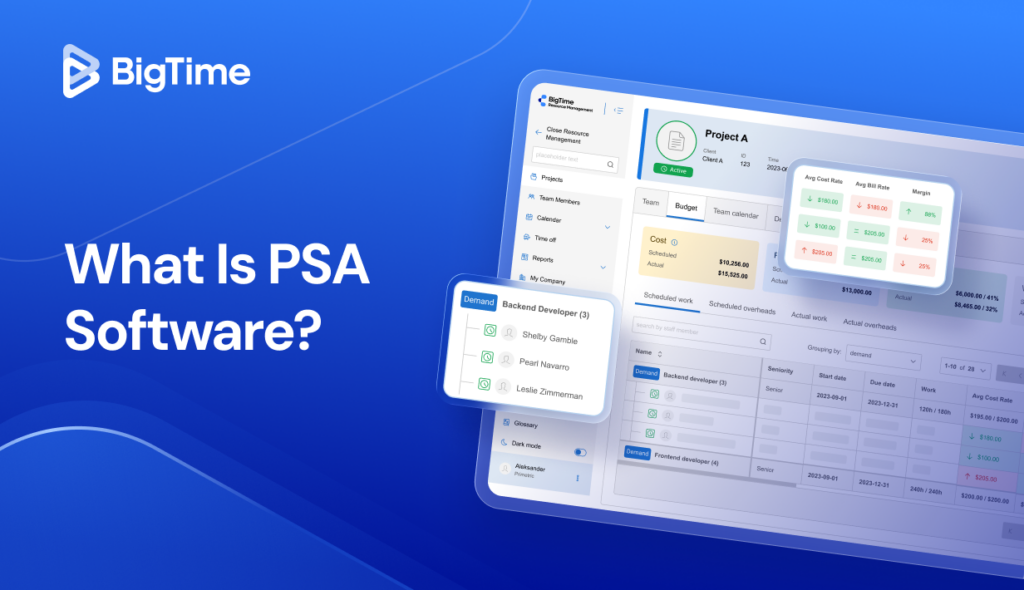
PSA software – short for Professional Services Automation (PSA) – is an integrated platform that helps service-based businesses manage their core business processes in one place. It combines project management, resource management, time tracking, financial management, billing, and reporting into a single system, replacing the need for multiple disconnected tools.
Think of a PSA system as the operational backbone of a professional services firm. It connects the entire project lifecycle, from the initial quote and resource planning, through project delivery and time capture, all the way to invoicing and financial reporting. The result is real-time visibility into every project, every resource, and every dollar, which means fewer surprises in resource scheduling and expense tracking, healthier margins, and better client satisfaction.
Who Can Benefit From Using PSA Tools?
Any business that delivers billable work can benefit from using PSA tools in their entire lifecycle. In practice, that means consulting firms, IT services providers, marketing and creative agencies, architecture and engineering firms, legal practices, and managed service providers (MSPs). What these professional services organizations have in common is that their revenue depends on resource utilization – and their profitability depends on how accurately they track, plan, and bill that time.
PSA solutions are especially valuable for professional services teams that are scaling. When a firm is small, manual processes for financial management and resource planning can hold together. But as projects multiply, project managers find themselves drowning in spreadsheets, delivery teams lose visibility into capacity planning, and finance can’t get clean financial data fast enough to make good decisions. A PSA system creates the structure that lets professional services firms grow without losing control of their project performance or financial health.
Professional Services Automation Software: Key Features
Integrated PSA software brings together the operational, financial, and strategic tools that professional services teams rely on every day. Here are the four core capability areas that define a modern PSA solution.
Project Budgeting and Financial Management
This is what lies at the core of the impact of the PSA software. A purpose-built PSA system connects time tracking and expense management directly to project accounting and invoicing, eliminating manual data entry, reducing errors, and giving finance teams accurate financial tracking across every engagement.
Key capabilities for financial management include:
- Time and expense management with automated approval workflows
- Project budgeting tools that track burn rate against planned budgets in real time
- Automated billing tools tied to tracked time and milestones, supporting fixed-fee, time-and-materials, and retainer models
- Revenue management and project profitability reporting at both the engagement and firm-wide level
- Expense tracking with receipt capture and categorization
- Cash flow visibility and financial forecasting to protect financial health
- Integration with existing accounting software and accounting tools for seamless month-end close
Project Management
At the heart of any PSA tool is the ability to manage projects across the entire project lifecycle. That means planning work before it starts, tracking project progress as it unfolds, and capturing outcomes once it’s complete. Unlike standalone project management software, PSA platforms connect project data directly to resourcing, billing, and financials, so project status updates flow automatically into the rest of the business.
Key project management capabilities in PSA systems include:
- Task scheduling, dependencies, and project milestone tracking
- Gantt charts and project planning views for project managers
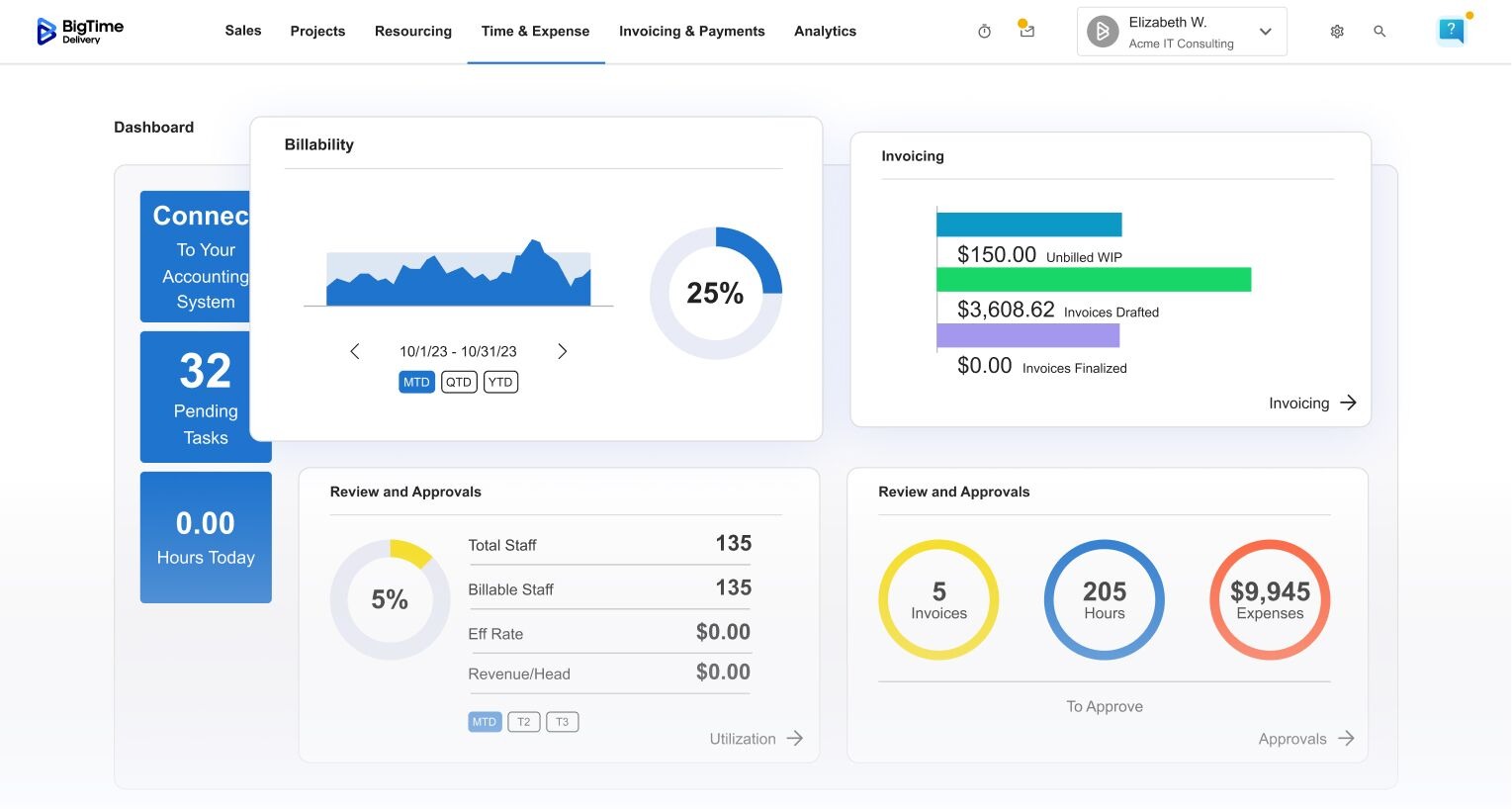
- Real-time executive dashboards showing project status and project performance across all active engagements
- Automated alerts when projects go off-track or over budget
- Collaboration tools for both internal delivery teams and client-facing communication
Resource Management
Effective resource management is what separates profitable professional services firms from ones that constantly scramble. PSA software gives project managers and operations leaders complete visibility into who is available, what they’re working on, and how their capacity maps to upcoming demand. This makes resource allocation proactive rather than reactive, and improves utilization rates across the board.
Key resource management features in PSA tools include:
- Resource scheduling and capacity planning across teams and business units
- Real-time utilization tracking to identify overloaded or underutilized staff
- Resource allocation tools that match the right people to the right projects
- Resource forecasting views that surface future capacity gaps before they become delivery problems
- Talent management features that factor in skills, certifications, and availability
AI-Powered Features
Modern professional services automation software doesn’t just automate manual processes; it uses AI to surface insights and recommendations that help teams work smarter. AI features are increasingly central to what separates best-in-class PSA solutions from legacy tools, offering features such as:
- Predictive resource planning that anticipates capacity gaps based on pipeline data
- AI-assisted project planning that recommends timelines and staffing based on historical project performance
- Intelligent alerts that flag at-risk projects before delivery problems escalate
- Automated real-time data entry and time capture that reduces the burden on billable staff
- Smart financial forecasting that identifies trends in project profitability and resource utilization

Benefits of PSA Software
Implementing professional services automation delivers measurable improvements across operations, finance, and client relationships. A well-implemented PSA tool changes how project delivery teams experience their work: less admin, more clarity, and greater confidence in every decision.
The key benefits include:
- Improved resource utilization. Eliminate guesswork in resource scheduling and ensure billable staff are allocated efficiently across all active projects.
- Faster, more accurate billing. Automated billing and expense tracking means invoices go out faster, with fewer errors, improving cash flow and client satisfaction alike.
- Real-time visibility. Leadership and project managers get a live view of project performance, financial health, and services delivery across the entire business.
- Reduced manual processes. Automating time-consuming tasks like data entry, reporting, and approval workflows frees up time for higher-value work.
- Better project profitability. Accurate financial management and project accounting help teams identify where margin is being lost — and fix it before the engagement closes.
- Stronger client relationships. When projects are delivered on time, invoices are accurate, and updates are proactive, client satisfaction improves naturally.
PSA vs Other Systems: What’s The Difference?
Before you evaluate PSA software, it helps to understand how it differs from the other platforms you may already be using. PSA tools overlap with ERP, CRM, and project management tools in some areas – but they’re purpose-built for the workflows that make professional services businesses run.
PSA vs ERP
Enterprise resource planning software (ERP software) is designed for product-based businesses: manufacturing, distribution, retail. It manages inventory, supply chains, human resources, and company-wide financials. PSA and ERP systems share some financial management functionality, but ERP lacks the project-centric features that professional services teams need: billable time tracking, project-level profitability analysis, and services-specific billing models. PSA software is, in effect, an ERP purpose-built for services organizations.
| PSA Software | ERP | |
| Primary focus | Service delivery, project profitability, billable time | Manufacturing, inventory, supply chain |
| Time tracking | Core feature, built for billable hours | Basic or absent |
| Project accounting | Native, project-level P&L | General ledger focused |
| Best for | Professional services firms, consulting, MSPs | Product companies, manufacturers |
PSA vs CRM
Customer relationship management (CRM systems) are built for managing the sales pipeline: tracking leads, contacts, and deals. PSA software picks up where CRM systems leave off, managing the actual delivery of the work, the resources, the financials, and the client relationship over the entire lifecycle of an engagement. However, many PSA solutions integrate natively with existing CRM platforms, creating a seamless handoff from customer success to project delivery.
| PSA Software | CRM | |
| Primary focus | Project delivery, billing, resource management | Sales pipeline, lead management, deal tracking |
| Post-sale workflow | Full project and financial management | Limited or none |
| Time & billing | Native core feature | Not included |
| Best for | Ongoing client project management | Pre-sale relationship management |
PSA vs Project Management Tools
Project management tools help teams organize tasks and track work. They’re useful for managing project planning and project progress – but they’re not built for the financials.. They typically lack native time tracking, expense tracking, billing, and resource utilization features. PSA software covers everything project management software does, plus all of the above.
| PSA Software | Project Management Tools | |
| Time & billing | Native, connected to projects and financials | Not included or basic |
| Resource utilization | Full capacity planning and scheduling | Basic workload views only |
| Financial management | Project P&L, invoicing, revenue management | Not included |
| Best for | End-to-end services delivery and billing | Task and project tracking |
How To Choose The Right PSA Solution?
When you evaluate PSA software, the goal isn’t to find the platform with the longest feature list. It’s to find the one that fits how your professional services organization actually works, and that will scale with you as you grow. Here’s how to approach the evaluation:
- Map your current workflow gaps. Before looking at any platform, identify where your core business processes break down today. Is it resource scheduling? Time and expense management? Project accounting? Revenue leakage? The right starting point is your biggest pain, not the most impressive demo.
- Assess integration with your existing software ecosystem. A PSA tool that doesn’t connect to your existing tools will create new problems. Check for native integrations with your accounting software (such as Quickbooks), CRM systems, and any collaboration tools your team uses daily. The smoother the integration, the less disruption to your existing software stack.
- Evaluate usability for delivery teams. PSA software only works if your team actually uses it. If logging time or submitting expenses feels like friction, billable hours will go uncaptured. Look for platforms where manual data entry is minimal and the interface is intuitive for both project managers and billable staff.
- Look for real-time financial visibility. The best PSA solutions give finance teams real-time data on project profitability, cash flow, and financial performance, not just historical reports. This is what enables proactive business management instead of reactive damage control.
- Consider implementation and data migration. Moving to a new PSA system involves data migration from your existing software and a period of change management. Ask vendors about onboarding timelines, migration support, and what happens to your existing tools and data during the transition.
- Verify scalability. As your services organization grows, your PSA platform should grow with you, handling more projects, more business units, and more complex financial data without requiring a replacement.
PSA Software Comparison Table
Use this quick-reference table to compare the top PSA tools side-by-side before diving into the detailed reviews below.
| Tool | Best for | Starting Price | G2 Overall | Ease of Use | Quality of Support |
| BigTime | Consulting & professional services firms (IT, engineering, and more) | From $20/user/mo | 4.5 / 5 1,661 reviews | 8.7 | 9.2 |
| Kantata | Firms needing advanced resource management | ~$45–50/user/mo | 4.2 / 5 1,505 reviews | 7.7 | 8.3 |
| Accelo | Businesses managing client work, retainers & recurring projects | ~$50/user/mo | 4.4 / 5 556 reviews | 8.1 | 8.7 |
| Scoro | Data-driven agencies & consultancies | From $26/user/mo | 4.5 / 5 491 reviews | 8.8 | 8.8 |
| Certinia PS Cloud | Salesforce-native enterprises looking toexpand their digital ecosystem | Custom pricing | 4.3 / 5 708 reviews | 7.9 | 8.1 |
| ConnectWise PSA | Enterprise MSPs with complex ITservice workflows | ~$35–65/user/mo | 3.9 / 5 519 reviews | 7.2 | 7.3 |
| Birdview PSA | Teams needing visual resourcescheduling & capacity planning | From $24/user/mo | 4.2 / 5 409 reviews | 8.4 | 8.8 |
| Source: | G2 scores from G2.com verified users · G2 does not accept payment to influence rankings · Starting price: published prices from vendor websites; estimates (~) are third-party aggregates from SelectHub, Vendr, and ITQlick — not confirmed by vendors · Best for descriptions are editorial · April 2026 |
1. BigTime — Best for professional services firms needing deep financial controls
Best for: consulting firms, professional services firms, accounting, IT & engineering organizations
BigTime: Pros & Cons
Pros
- Built around the General Ledger, not just integrated with it – one financial logic from quote to cash
- Supports all major billing models (T&M, fixed-fee, milestone, retainer) within a single system
- Deep, bi-directional QuickBooks and Sage Intacct integrations that finance teams can actually trust
- Real-time project profitability, WIP visibility, and budget vs. actuals without manual reconciliation
Cons
- Steeper learning curve than lighter-weight PSA tools — initial configuration takes time
- Interface can feel dense for smaller teams that don’t need its full financial management depth
BigTime is the financial-precision PSA for mid-market professional services firms – built for the moment when billing complexity, utilization pressure, and cash flow risk outgrow QuickBooks plus a time tracker, but an enterprise transformation isn’t the answer.
Where other PSAs integrate with your accounting system, BigTime is built around it. Every billing rule, rate card, and revenue recognition decision lives in a single financial logic – consistent from the first quoted hour to the last collected payment. The result: no manual reconciliation between the PSA and the GL, no margin that goes invisible until month-end close.
Key features:
- Multi-model billing: time-and-materials, fixed-fee, milestone billing, and retainer structures in a single system
- Real-time project profitability analysis with budget vs. actuals tracking and threshold alerts
- Integrated expense tracking linked directly to client projects and billing data
- Gantt-style project planning with task management and project tracking views
- Utilization tracking and resource planning by team members across multiple client projects
- Flexible time entry — desktop, mobile, and browser-based — with automatic billable hours capture
- Native integrations with QuickBooks, Sage Intacct, Salesforce, and Jira
Why should you choose BigTime?
BigTime wins for firms where billing accuracy equals revenue. The GL-native architecture means financial precision is the foundation, not an afterthought — and every module added (resource management, quoting, payments) inherits that same financial logic without requiring re-platforming. Firms that need a system that evolves with them — not a new platform every few years — consistently land on BigTime.
2. Kantata — Popular with small to medium professional services firms
Kantata – Pros & Cons
Pros
- Industry-leading resource management for large professional services teams
- Strong financial visibility and financial reporting suited to enterprise-scale operations
- Mature integrations with major ERP, CRM, and accounting systems
- Broad professional services coverage across consulting, technology, and creative verticals
Cons
- Custom pricing that is not cheap, and complex implementation measured in weeks, not days
- Rewards heavy configuration investment.
- Easily over-engineered for smaller teams or those without a dedicated operations owner
Kantata (formerly Mavenlink) is a well-established PSA platform with resource management and financial reporting capabilities. For many companies, its breadth of functionality is hard to match. The resource planning engine in particular is one of the most sophisticated in the market — providing granular visibility into availability, skills, and utilization.
The honest caveat is that Kantata’s depth comes at a cost — in setup time, configuration effort, and dollars. The platform requires significant implementation work to deliver its full value, and organizations that underinvest in onboarding often find themselves using only a fraction of the available features. Smaller professional services firms may find the complexity more of a burden than a benefit.
Key Features
- Resource planning engine with skill-based allocation, utilization tracking, and availability forecasting
- Financial management: revenue recognition and financial reporting
- Project tracking with Gantt charts and milestone billing support.
- Business intelligence dashboards covering project performance and financial metrics
- Configurable workflows for project delivery, approvals, and client communication
3. Accelo — For teams managing quote to cash
Accelo – Pros & Cons
Pros
- Automated time capture from client communication.
- Retainer management for teams handling recurring client engagements
- Flexible billing model support for mixed-contract client portfolios
- Solid QuickBooks and Xero integrations for finance teams
Cons
- Interface has a well-documented learning curve that slows initial adoption
- Not strongly specialized in any single vertical; can be outperformed by more focused competitors
- Some users report that the platform feels complex relative to the workflow value it delivers
Accelo’s automated time capture is a genuine differentiator. The platform monitors client communication — emails, meetings, calls — and turns that activity into time entries automatically, which addresses one of the most persistent problems in professional services: billable hours that never make it onto an invoice.
Beyond that core feature, however, Accelo is a more mixed proposition. The interface has a reputation for feeling cluttered and unintuitive until users invest significant time in learning it. Financial reporting, while serviceable, lacks the depth and flexibility. And while Accelo handles a mixed contract portfolio well, it is not particularly specialized in any one area.
Key Features
- Automated time capture from email, calendar, and client communication.
- Retainer management with recurring billing, scope tracking, and overage alerts
- Project planning with task management, budget tracking, and real-time project status views
- Client communication centralization: shared portals, approval workflows, automated updates
- Integrations with QuickBooks, Xero, Salesforce, and G Suite
4. Scoro — For good financial visibility across projects
Scoro – Pros & Cons
Pros
- Best-in-class financial visibility and reporting for professional services firms
- Sophisticated quote-to-cash workflow with margin calculations built into estimation
- Real-time project profitability tracking enables proactive financial management
- Strong accounting tool integrations for finance teams
Cons
- Higher price point than many comparable PSA tools for professional services — hard to justify for smaller teams
- Interface complexity can be daunting; new users often need dedicated onboarding time
- Resource management less deep than specialist tools in this area
- Less suited to MSP workflows or teams that need strong service desk functionality
Scoro’s core strength is financial visibility, and it delivers on that promise better than most PSA platforms in the mid-market. The quote-to-cash workflow is thorough, the financial dashboards are genuinely well-designed, and the real-time budget vs. actuals tracking is among the most reliable in its category.
Where it falls short is in breadth. The resource management capabilities, while adequate, lack the depth of other dedicated tools. Client communication features are functional but not particularly differentiated. And for teams that aren’t financially sophisticated, Scoro’s depth can feel like complexity for its own sake.
Key features
- Quote-to-cash workflow with multi-scenario proposals and margin calculations
- Real-time financial visibility: budget vs. actuals, project profitability, and revenue forecasting
- Resource management with capacity planning and workload balancing
- Client portals, shared work reports, and approval workflows for client communication
- Billing automation and invoice creation with support for multiple billing models
- Integrations with QuickBooks, Xero, Sage, and Salesforce
5. Certinia PS
Certinia PS – Pros & Cons
Pros
- Deepest Salesforce integration available in the PSA market.
- Real-time financial visibility across revenue recognition, project profitability, and resource utilization in a single platform
- AI-driven resource staffing and capacity planning via Salesforce Einstein
- Strong revenue recognition automation across complex, multi-model billing structures
Cons
- Only viable for Salesforce customers
- Customization requires Salesforce admins or developers
- Page load performance under heavy usage is a recurring user complaint, particularly when handling large data sets
- Native invoicing requires purchasing the separate Certinia Billing & Receivables application.
Certinia PS Cloud (occupies a distinctive position in the professional services automation market: it is the most deeply Salesforce-native PSA available. Rather than connecting to Salesforce via an API, Certinia lives inside the Salesforce platform — meaning project data, resource schedules, revenue forecasts, and customer records all share a single data model and update in real time without synchronization delays.
The practical benefit is visibility that other PSA tools struggle to replicate. Project managers, account executives, and finance teams all work from the same customer record. A deal closed in Salesforce Sales Cloud can become a project in Certinia PS Cloud without manual re-entry. Still, this is a viable option only for companies already working with Salesforce.
Key features
- Salesforce-native architecture — project, resource, and financial data share a single record with CRM and sales data, with no middleware or sync required
- Revenue recognition automation aligned to accounting standards.
- Services Estimator: generate accurate project estimates from a single source of truth.
- Real-time project analytics and financial reporting via Certinia PS Cloud Analytics.
- Project lifecycle management from opportunity to delivery.
6. ConnectWise PSA — For complex MSP operations
ConnectWise PSA: Pros & Cons
Pros
- Most mature and comprehensive PSA platform in the MSP market
- Deep integration ecosystem that newer platforms have not yet replicated
- Enterprise-grade financial management and billing controls at scale
- Highly configurable to match complex MSP operational requirements
Cons
- Interface complexity and legacy architecture make the learning curve steep for new users
- Implementation typically requires paid professional services support.
- Cloud-native competitors offer a noticeably better user experience for day-to-day technician workflows
- Premium pricing with limited transparency; buyers should budget conservatively
ConnectWise PSA is the incumbent enterprise platform for managed service providers, and its position at the top of the MSP market is not undeserved. The integration ecosystem is genuinely broad – RMM platforms, security vendors, accounting tools, and specialist applications – and the depth of configurability is good for organizations with complex billing structures.
The honest downside is that ConnectWise PSA is showing its age. The interface is complex in a way that feels like accumulated legacy rather than intentional design, and the learning curve for new technicians is a recurring complaint in user reviews. Implementation typically requires professional services engagement, adding cost that doesn’t appear in the base pricing.
Key features
- Comprehensive MSP operations: ticketing, project management, time tracking, billing automation, and financial management
- Deep integration ecosystem: RMM platforms, security tools, accounting systems, and specialist MSP applications
- Highly configurable workflows, billing models, SLA parameters, and reporting dimensions
- Enterprise financial management: revenue recognition, multi-entity billing, and detailed financial reporting
- Remote monitoring integrations for unified service delivery and endpoint management
- Client communication tools with project status tracking and client portal access
7. Birdview PSA — For visual resource planning
Birdview PSA – Pros & Cons
Pros
- Best-in-class visual resource planning – more intuitive than most PSA resource management tools
- Capacity forecasting and resource loading simulation support proactive planning
- Project scorecard provides quick visibility into delivery health across the portfolio
- Broad integration ecosystem for teams with diverse existing systems
Cons
- Financial management and billing capabilities lag behind specialist tools
- MSP-specific features are limited – not a competitive option for IT service providers
- Learning curve for users new to PSA systems can be steeper than the visual interface suggests
- Integration quality varies; the 5,000+ figure includes many lightweight connectors
Birdview PSA’s visual resource scheduling is its clear differentiator, and it earns the top spot in that specific capability area. The live capacity view is genuinely more intuitive than the tabular resource reports most PSA tools offer. For professional services teams where resource allocation decisions are daily and high-stakes, that visual clarity has practical value.
Outside resource management, Birdview PSA is a less compelling story. Financial management features are functional but not deep – the billing and invoicing tools cover the basics without the financial controls. MSP-specific capabilities are limited. And while the 5,000+ integration claim sounds impressive, the depth and reliability of those integrations varies significantly.
Key features
- Visual resource scheduling: live capacity view with allocations, availability, and demand forecasting
- Project scorecard: at-a-glance health indicators for budget and timeline.
- Time tracking and expense tracking integrated with billing and invoicing
- Project profitability reporting with budget vs. actuals tracking
Frequently Asked Questions About PSA Software
What is PSA software?
PSA (Professional Services Automation) software is a platform that helps services firms manage projects, resources, time tracking, billing, and financials in one place. It’s used across consulting, IT, engineering, and similar industries to streamline operations and improve project profitability.
What does PSA stand for in software?
PSA stands for Professional Services Automation.
What is the difference between PSA and project management software?
Project management software focuses primarily on task management, project timelines, and team collaboration. Professional services automation software is broader — it connects project delivery to financial management, resource planning, billing automation, and client relationship management.
What are the key features in PSA software?
The key features in PSA software include project management, resource planning and forecasting, time and expense tracking, budgeting and financial management, billing and invoicing, and reporting and analytics. Leading platforms like BigTime also offer accounting integrations, customizable dashboards, and workflow automation.
What are the examples of PSA software?
Some of the best PSA software examples include:
- BigTime – Top-rated PSA platform for time, billing, and profitability management.
- Accelo – PSA and CRM solution for smaller service businesses.
- Kantata (Mavenlink + Kimble) – Enterprise-grade PSA for resource-heavy teams.
- Scoro – Business management and PSA suite for agencies.
- FinancialForce PSA (Certinia) – Salesforce-based PSA for large enterprises.
What is the best PSA software overall?
BigTime is the best PSA software. It delivers a complete, intuitive platform covering project management, resource planning, time tracking, budgeting, and invoicing with deep accounting integrations and real-time reporting that give firms full visibility into performance and profitability.
What is the best PSA software for mid-sized companies?
BigTime is the best PSA software for mid-sized firms. Built for companies with 50–500 employees, it offers enterprise-grade features: resource forecasting, custom workflows, and financial dashboards, without the complexity of legacy systems, making it ideal for growing professional services organizations.
What is the best PSA software for small business?
BigTime is the best PSA software for small business. It combines time tracking, billing, and financial management in a single platform without the setup complexity of enterprise-grade tools, so a small professional services firm can get up and running fast and start capturing billable hours accurately from day one. For firms weighing their options, PSA software for small business covers what to prioritize when the team and budget are still lean.
What is the best PSA software for different industries?
BigTime is the best PSA software across a wide range of industries and use cases:
- Consulting firms – Supports the full engagement lifecycle, from project scoping and resource allocation to time tracking, client billing, and profitability reporting.
- IT services companies – Handles complex multi-phase projects, accurate billable hour tracking, resource demand forecasting, and automated invoicing, with integrations for existing accounting and CRM tools.
- Engineering firms – Supports project-based workflows with budget tracking, resource scheduling, expense management, and compliance-ready reporting.
- Other professional services companies.
Is PSA software worth it for small professional services businesses?
Yes — particularly if your team is managing multiple concurrent client projects and tracking billable hours manually. Even a small professional services firm losing 10–15% of billable hours to incomplete time tracking or manual billing processes can recover significant revenue through PSA software for small business. Start with a tool that has a low learning curve and scales predictably, such as BigTime
How long does PSA software implementation take?
Implementation timelines range from a few days (for lightweight tools like Productive or Accelo) to several months (for enterprise PSA platforms like ConnectWise or Kantata). The primary variables are data migration complexity, integration requirements with existing systems, and the number of users requiring training. Most professional services teams should budget 2–8 weeks for a fully functional deployment.