Billing is one of those business processes that looks simple until it starts breaking. A few missed billable hours, a messy approval chain, or unclear invoice templates can quickly lead to payment delays, overdue payments, and awkward client communications. For service-based businesses, the cost is not just time. It is revenue leakage, forecasting issues, and a billing process that feels harder every month.
The right billing software brings order to that chaos. Modern billing software solutions help you track billable hours, create professional invoices, automate invoices (including recurring billing), and accept payments online in a timely manner. The best billing and invoicing software also supports accurate billing with clear payment status visibility, automated payment reminders, and reporting that helps you analyze trends and improve cash flow.
What You’ll Find in This Article
- A clear definition of billing software and what it’s built to solve
- The biggest benefits of online billing software for growing teams
- The must-have features in billing management software (from recurring invoices to expense tracking)
- A 2026 billing software ranking (plus what matters in 2026 buying decisions)
- A comparison table for 15 billing software options
- In-depth reviews of the top billing tools
What Is Billing Software?
Billing software is a digital system that helps businesses turn completed work, delivered services, or shipped products into revenue in a consistent, trackable way. Instead of juggling spreadsheets, disconnected project accounting software, and manual follow-ups, a billing system centralizes the steps that matter most: calculating charges, generating invoices, sending them, collecting payments, and tracking what is still outstanding.
In practice, invoice billing software is used to solve common challenges like:
- Accurate billing for services based on billable hours, rates, and billing codes.
- Faster invoicing at scale with multiple invoices, batch invoicing, and online invoices ready in just a few clicks.
- Recurring invoices and subscriptions with automated invoices and recurring invoices.
- Monitoring overdue payments, reducing late payments with invoice reminders, and improving cash flow with real-time reporting.
- Automated follow-ups and automated payment reminders (including automatic reminders).
- Payment collection options: Accept payments online via card payments, bank transfers, and payment gateways, sometimes including Apple Pay, so clients can pay the way they prefer.
- Expense tracking, inventory management, and integrations that connect billing management software to accounting workflows and sales processes.
The best online billing software goes beyond “send invoices and hope for the best.” It supports a repeatable billing process with clear approval steps, standardized invoice templates, and automation that keeps revenue moving even when teams get busy. For service-based businesses in particular, strong time and billing software becomes the backbone for turning project work into predictable income, while maintaining customer satisfaction through clear, professional invoices and timely payment experiences.
The Benefits of Billing Software
Billing is not just about sending invoices. It is about protecting revenue, accelerating cash flow, and keeping the client experience smooth even as you scale. The best billing software creates structure around the billing process so your team can bill consistently, reduce errors, and spend less time chasing payments.
Here are the biggest benefits you can expect from modern billing management software:
- Get paid faster with fewer payment delays. Online billing software makes it easier to request payment the moment work is approved. With online payments, embedded payment processing, and options like card payments or bank transfers, clients can pay immediately instead of pushing invoices to the bottom of their inbox.
- Improve cash flow visibility and forecasting. When invoices, payment status, and collections live in one place, you can see what is outstanding and what is coming in. Many billing software solutions include executive dashboards or reports that help you analyze trends, spot bottlenecks in the billing process, and improve cash flow planning.
- Increase accuracy and cut revenue leakage. For service-based businesses, the biggest losses often come from underbilling or missed billable hours. Time and billing software helps teams track billable hours, apply the right rates or billing codes, and reduce errors before invoices go out. That means more accurate billing and fewer surprises for clients.
- Save time with automation and repeatable workflows. Whether you are sending unlimited invoices or handling multiple invoices across many clients, automation matters. Features like batch invoicing, recurring invoices, and the ability to automate invoices mean billing happens on time, even during busy periods.
- Create more professional invoices that strengthen trust. Clean invoice templates and customizable templates help you create professional invoices that look consistent and credible. That polish influences customer satisfaction because clients can quickly understand charges, payment terms, and where to pay.
- Support business growth without adding headcount. As you grow, the billing system either becomes a bottleneck or a lever. The best billing and invoicing software standardizes your billing process so you can expand to more clients, more projects, and more complex pricing without chaos or hidden fees creeping into operations.
What Features Should The Best Billing Software Have?
The best billing software does more than generate invoices. It creates a repeatable billing process that protects margins, improves cash flow, and makes it easy for clients to pay on time. When you are comparing billing software options, focus on features that support accurate billing today and scale cleanly as you add more clients, projects, and revenue streams.
Flexible invoice creation and customization
A strong invoice billing software platform should let you create professional invoices quickly, using customizable templates that match your brand and billing style. Beyond basic invoice templates, the tool should support custom fields, flexible formatting, and region-specific currencies so invoices are consistently accurate. Ideally, you can generate digital invoices in minutes, reuse layouts for different service lines, and standardize terms so clients always know what they are approving and paying for.
Time tracking and billable hours controls
For service-based businesses, time and billing software is only as good as its ability to capture billable hours accurately. Look for time tracking that makes it easy to log work in real time, tie time entries to projects or tasks, and apply different rates by role, client, or engagement type. Strong controls matter too, including approvals, audit trails, and the ability to lock periods so your billing process stays consistent and you reduce errors when invoices are created.
Automated billing and invoice automation
Automation is where billing management software starts paying for itself. Prioritize tools that can automate invoices based on rules (for example, billing project milestones, monthly schedules, or approved time and expenses) and that can handle edge cases without forcing manual workarounds. The best systems also streamline the “in-between” steps like drafting, approvals, and sending invoices, so billing happens in a timely manner even during busy close periods. The goal is fewer missed invoices, fewer inconsistencies, and less time spent rebuilding the same invoice every cycle.
Recurring billing and recurring invoices
If you run retainers, subscriptions, or fixed monthly services, recurring billing is non-negotiable. The best online billing software lets you schedule recurring invoices, adjust them without breaking the schedule, and manage changes like scope expansions, pauses, or one-off charges cleanly. A good recurring invoices workflow also reduces revenue leakage by ensuring nothing slips through the cracks when clients renew, change plans, or add services mid-month.
Online payments and broad payment acceptance
To get paid faster, clients need frictionless ways to pay. Look for billing software that can accept payments online through reliable payment gateways, accept credit cards, and support card payments plus bank transfers so clients can choose what is easiest for them. If your customers prefer mobile-first payments, support for options like Apple Pay can shorten the time between “invoice received” and “invoice paid.” Pay attention to how payment processing fees work too, since hidden fees can add up quickly at scale.
Expense tracking and reimbursables
Billing is rarely just labor. Expense tracking and the ability to track expenses (including reimbursable pass-through costs) prevents underbilling and helps keep invoices clean and defensible. The best billing software solutions let you attach receipts, categorize expenses, allocate them to the right client or project, and control which costs are billable versus internal. When reimbursables flow into invoices smoothly, you reduce errors and avoid uncomfortable back-and-forth later.
Batch invoicing and high-volume workflows
If you invoice many clients at once, you need batch invoicing that actually works. Strong tools can create multiple invoices in bulk, automate invoice generation for grouped clients or projects, and still give you a review layer before anything is sent. This matters for teams that need to send invoices at scale without sacrificing accuracy, especially when there are different rates, billing codes, or service bundles involved. The best systems also support unlimited invoices without forcing you into clunky exports or manual formatting.
Payment status visibility and reporting
You should never have to guess what is paid, pending, or overdue. A modern billing system shows real-time payment status, flags overdue payments clearly, and keeps a visible timeline of invoice activity so your team can act quickly. Reporting should go beyond totals and include aging, collections performance, and trends that help you analyze trends over time. When you can see where payment delays start, it becomes easier to tighten the billing process and improve cash flow.
Integrations with accounting software and business systems
Billing rarely lives alone. The best billing and invoicing software offers seamless integration with accounting software so invoice data, payments, and balances stay aligned without duplicate entry. Look for integrations that also support common workflows like syncing clients, exporting financial data, and reconciling payments to a bank account in a way finance can trust. If your sales processes or project tracking tools feed billing, integrations can also reduce errors by keeping source data consistent across systems.
2026 Billing Software Ranking
This 2026 billing software ranking is built for teams that want more than “basic invoicing software.” The tools below were selected to cover the full range of billing needs, from straightforward online invoices to full time and billing software that helps professional services teams track billable hours, reduce revenue leakage, and get paid faster. You’ll see platforms that focus on recurring billing and automated payment reminders, tools that lean into payment processing and “accept payments online,” and systems that prioritize accurate billing workflows and reporting to improve cash flow.
To keep the list practical (and not just popular), the ranking emphasizes what actually impacts billing outcomes: how easy it is to create professional invoices at scale, whether you can automate invoices and schedule recurring invoices without hacks, how clearly the billing system shows payment status and overdue payments, and how well it supports expense tracking, approvals, and integrations with accounting software. In 2026, those fundamentals matter even more because clients expect digital invoices, quick online payments, and fewer billing errors.
2026 Best Billing Software List
- BigTime
- QuickBooks Online
- FreshBooks
- Zoho Invoice
- Xero
- BILL
- Stripe Invoicing
- Square Invoices
- PayPal Invoicing
- Sage Intacct
- NetSuite
- Wave
- Invoiced
- Harvest
- Clockify
Best Billing Software: Comparison
| Tool | Description | Strengths | Limitations |
| BigTime | Time and billing software for service-based businesses that need accurate billing, automation, and real visibility into billable work. | Excellent for tracking billable hours, controlling approvals, and reducing revenue leakage; strong invoicing workflows and reporting for cash flow. | Not designed as a full inventory-first retail billing system; best fit is professional services and project-driven teams. |
| QuickBooks Online | Popular accounting software with invoicing bolted onto a finance-first workflow, often chosen because it is “good enough” out of the box. | Familiar interface for many small businesses; solid invoice templates, online payments, and basic reporting in one place. | Time and billing depth is limited without add-ons; invoice automation and approvals can feel clunky; scaling teams often run into admin friction and tier constraints. |
| FreshBooks | Invoicing software aimed at freelancers and small teams, optimized for simplicity rather than complex billing operations. | Quick to create professional invoices; decent automated payment reminders and a client-friendly payment experience. | Costs rise fast with users/features; weaker controls for complex billing codes and multi-layer approvals; reporting can feel shallow for billing management. |
| Zoho Invoice | Online billing software focused on invoice creation and recurring invoices, best when you already live in the Zoho ecosystem. | Strong value for customizable templates and basic automation; supports recurring billing, payment links, and client-facing workflows. | Standalone use can feel limiting; advanced analytics and process controls are not as strong; integrations outside Zoho may require extra effort to stay reliable. |
| Xero | Accounting-led platform where invoicing is solid, but many “billing system” needs rely on surrounding apps and integrations. | Good accounting foundation; clean online invoices and strong bank reconciliation for finance teams. | Project-based billing and time tracking are not native strengths; batch invoicing and approvals can be less streamlined; the best setup often depends on add-ons. |
| BILL | AR/AP automation system built for finance operations, not for teams that need time tracking-driven invoice billing software. | Strong approvals, payment workflows, and controls for payables/receivables; helpful for reducing payment delays at the finance layer. | Can be heavyweight if invoicing is your primary need; limited support for billable hours workflows; customization and reporting may feel rigid without enterprise configuration. |
| Stripe Invoicing | Payment-processing-first invoicing solution that works best for straightforward billing tied tightly to Stripe checkout. | Excellent for accepting payments online, card payments, and payment gateways; strong developer-friendly automation for digital flows. | Not a full billing management software: limited for billable hours, complex approvals, and service delivery workflows; finance reporting is payments-centric, not billing-process-centric. |
| Square Invoices | Square invoices tool for small businesses that prioritize quick invoicing and point-of-sale-friendly payments over advanced billing controls. | Easy setup; strong for in-person and online payments with a familiar customer experience. | Limited depth for recurring billing complexity, billing codes, and project-based billing; reporting can be basic; less suitable when you need accurate billing across many clients/projects. |
| PayPal Invoicing | Lightweight invoicing tied to PayPal that prioritizes speed over robust billing process management. | Fast way to send invoices and receive payments; familiar to many customers and simple to adopt. | Weak automation and limited invoice customization; reporting and payment status workflows can be basic; not ideal for scaling multiple invoices, approvals, or professional billing operations. |
| Sage Intacct | Midmarket financial management platform with strong accounting controls, where billing improvements often come with heavier implementation. | Strong governance, auditability, and reporting for midsize businesses; useful when finance controls matter most. | Higher cost and setup complexity; time and billing workflows are not the core strength; teams often need integrations or services to meet day-to-day billing needs. |
| NetSuite | Enterprise ERP that can handle complex billing, but requires serious investment, configuration, and ongoing admin ownership. | Very powerful for multi-entity operations and complex financial workflows; supports sophisticated billing scenarios. | Overkill for most small businesses; expensive and time-consuming to implement; customization burden can be high, and everyday invoicing agility can suffer. |
| Wave | Entry-level invoicing and basic accounting designed for very small businesses with simple needs and tight budgets. | Budget-friendly; simple invoicing and basic expense tracking for getting started. | Limited automation and weak controls for scaling; fewer integrations and reporting depth; not built for recurring billing complexity, approvals, or high-volume billing. |
| Invoiced | AR-focused billing management software built to improve collections, but not a complete answer for operational time-to-invoice workflows. | Strong collections workflows, reminders, and AR reporting that can improve cash flow discipline. | Less emphasis on time tracking, project billing, and service delivery workflows; may require significant integrations; can feel specialized if you need an all-in-one billing system. |
| Harvest | Time tracking tool with invoicing features that work well for simple service billing, but can top out as processes mature. | Excellent time tracking; easy conversion from billable hours to invoices; good for small agencies. | Limited invoice automation and recurring billing flexibility; approvals and billing controls can be light; scaling to complex billing operations often requires additional tools. |
| Clockify | Time tracking platform with basic invoicing add-ons, best suited for tracking hours rather than running full invoice billing software. | Strong for tracking billable hours at low cost; broad adoption and easy rollout for teams. | Invoicing depth is limited; weak automation, payment collection, and billing process controls; not ideal when you need end-to-end billing management and payments. |
BigTime
Reviews: G2: 4.5/5, Capterra: 4.6/5.
Pros:
- Purpose-built for accurate billing in service-based businesses. BigTime connects time tracking, billable hours, project budgets, and invoicing so your billing process is driven by real delivery data, not manual guesswork. That structure is exactly what helps teams reduce errors and avoid revenue leakage when projects get busy.
- Makes it easier to get paid faster and improve cash flow discipline. With centralized financial data and an A/R-focused view, BigTime is designed to help firms speed up invoicing and tighten collections workflows so payment delays do not become “normal.”
- Strong visibility for managers and finance. Users consistently highlight visibility into project budgets and billability, which helps teams understand performance and make adjustments before invoices go out. That’s a major differentiator compared to basic invoicing software that only starts tracking once an invoice is sent.
- Built to scale beyond “send invoices.” BigTime positions itself as a unified platform from quoting to cash flow, which is valuable for growing teams that need a real billing system, not just invoice templates and payment links.
Cons:
- Mobile experience can lag behind the desktop product. Reviews commonly point out that the mobile app feels less polished and can be less reliable than the PC experience, which matters if your team logs time on the go.
- Integrations can require attention as you scale. BigTime is frequently praised for QuickBooks integration, but some buyers should expect occasional syncing issues depending on how their accounting workflows are configured.
BigTime is time and billing software that feels like it was designed by people who understand how professional services actually run. Instead of treating invoicing as an isolated task, it connects time tracking, expense tracking, WIP, budgets, and billing workflows into a single system. That makes it easier to track billable hours accurately, generate professional invoices with confidence, and keep the billing process consistent even when projects, rates, and staffing change.
Where BigTime really stands out is how it supports operational discipline around billing management. With centralized financial data and an A/R-oriented approach, teams can manage work in progress more cleanly, forecast with more confidence, and remove the typical friction that slows invoicing down. For firms tired of payment status uncertainty, scattered data, and last-minute invoice scrambling, BigTime gives you the structure to automate what should be repeatable and keep billing moving in a timely manner.
Key Features
- Time tracking and billable hours capture: Track time consistently across projects so hours are categorized correctly and ready for accurate billing, not reconstructed at month-end.
- Billing and invoicing workflows: Streamline invoice creation and delivery so your team can move from approved work to sent invoices quickly, with fewer manual steps.
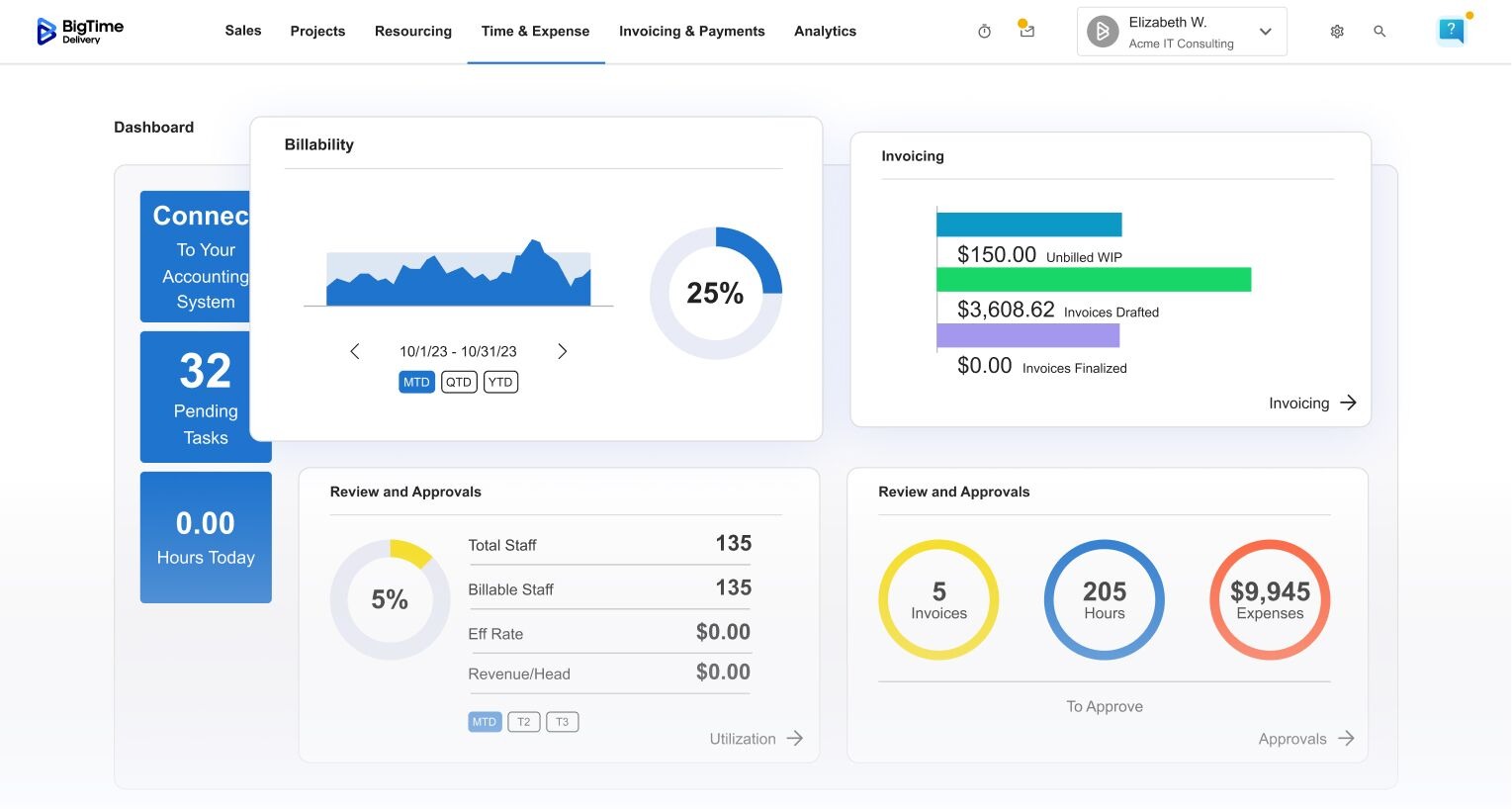
- Centralized financial visibility (WIP, budgets, margins): Bring financial and delivery data together so you can spot issues early, reduce revenue leakage, and make faster decisions that support cash flow.
- Reporting and analytics: Use reporting to monitor billability and performance trends, which helps leaders improve profitability and operational consistency over time.
- Integrations that support the billing process: Connect billing workflows with the rest of your stack so the handoff to accounting software is smoother and less error-prone.
Pricing: BigTime pricing is commonly listed as starting at $20 per user, per month, with a free trial available. Pricing and packaging can vary by plan and requirements, so teams typically confirm final costs through BigTime directly. Free personalized demo available.
QuickBooks Online
Reviews: G2: ~4.0/5, Capterra: 4.3/5.
Pros:
- Solid baseline if you want invoicing inside accounting software. It’s convenient for small businesses that want one place for invoicing, expense tracking, and basic reporting.
- Decent online payments experience. Paying from invoices is straightforward, which can help you get paid faster in simple workflows.
Cons:
- Invoice customization is a recurring complaint. If you need more control over professional invoices, layouts, or client-specific requirements, QuickBooks can feel restrictive.
- Time tracking is “basic” unless you step up to more robust options. Intuit explicitly positions QuickBooks Online time tracking as basic and points users to QuickBooks Time for more features.
- Pricing complexity can grow with you. Plans and feature boundaries vary, and the official pricing is tiered, which can push teams into higher monthly fees as needs expand.
QuickBooks Online works best when you want invoices tightly connected to bookkeeping and you do not need a sophisticated billing system. For straightforward billing process needs (send invoices, accept payments online, track expenses), it is a familiar and widely adopted option.
Where it starts to strain is when billing gets operational: heavier invoice automation, tighter approvals, deeper time and billing software requirements, or high-volume workflows. At that point, teams often end up adding tools, living with manual steps, or accepting compromises that create payment delays and reduce accuracy.
Key Features
- Invoicing + templates: Create and send invoices quickly, but customization depth is limited compared to billing-first platforms.
- Online payments: Lets customers pay via payment links, helping reduce friction for collections in simple setups.
- Basic time tracking: Supports tracking hours, but advanced time-tracking functionality is positioned as a separate, more robust product path.
- Accounting core: Strong bookkeeping foundation, but billing management features can feel secondary when processes get complex.
Pricing: Tiered subscription pricing varies by plan and market; Intuit lists plan pricing on its official pricing page, and third-party breakdowns commonly show a wide range across tiers.
FreshBooks
Reviews: G2: 4.5/5, Capterra: 4.5/5.
Pros:
- Easy invoicing for small businesses. FreshBooks makes it quick to create professional invoices, send online invoices, and keep the basics moving without much setup.
- Good starter automation. Recurring invoices and automated payment reminders help reduce manual follow-ups when your billing process is simple.
Cons:
- Pricing scales awkwardly for growing teams. Costs can jump as you add users or need higher-tier functionality, which turns “simple monthly fees” into a bigger commitment than many expect.
- Not great for complex billing operations. If you need deeper billing management software controls (approvals, nuanced billing rules, heavy batch invoicing), you’ll likely run into friction and workarounds.
- Support quality is not universally praised. Some reviewers point to slower response times, which matters when invoicing and payment processing issues block cash flow.
FreshBooks is best viewed as approachable invoicing software with light accounting features, aimed at freelancers and small businesses that want to send invoices, track expenses, and accept payments online without complexity. It’s fast to adopt, and the UI tends to feel less intimidating than many accounting-first platforms.
Where it falls short is when your billing system needs structure. As soon as you need tighter controls, more advanced reporting, or time and billing software depth that holds up under scale, FreshBooks can feel like it’s optimized for simplicity over accuracy and process discipline.
Key Features
- Invoice templates and customization: Lets you create professional invoices quickly, but customization depth can be limiting if clients demand strict formatting.
- Recurring invoices: Useful for retainers and repeating work, though flexibility can be weaker when billing rules get complicated.
- Automated payment reminders: Helps reduce late payments with scheduled follow-ups, but you may want more advanced collections workflows as volume grows.
- Expense tracking: Supports tracking expenses and attaching costs to clients/projects, but reporting depth may feel limited for finance-heavy needs.
- Online payments: Supports getting paid through integrated payment options, but total cost depends on processing fees and your plan setup.
Pricing: Capterra lists a Lite plan around $19/month when billed monthly (with lower effective pricing when billed annually), and higher tiers increase as features and client limits expand.
Zoho Invoice
Reviews: G2: 4.7/5, Capterra: 4.7/5.
Pros:
- Strong “free” value for basic invoice billing software. It covers core invoicing, recurring invoices, and client-facing billing basics without the typical price tag.
- Recurring invoices are genuinely usable. You can set up recurring billing profiles and keep repeat invoicing consistent without recreating invoices every cycle.
Cons:
- Limited depth for mature billing operations. If you need complex approvals, nuanced billing rules, or finance-grade controls, Zoho Invoice can start to feel lightweight and rigid.
- Support experiences can be uneven. Zoho’s broader product ecosystem gets frequent “inconsistent support” feedback, and Invoice users also report occasional friction when issues get specific.
- Best experience often assumes you’ll adopt more Zoho tools. As workflows expand, you may feel pushed toward the suite for deeper reporting, automation, or broader billing management.
Zoho Invoice is online billing software that works well when your needs are straightforward: send invoices, take payments, and keep recurring billing running without adding cost. It’s especially attractive to small businesses that want clean invoice templates, digital invoices, and simple automation without committing to higher monthly fees.
The tradeoff is scalability. Once you need tighter billing process controls, more advanced reporting to analyze trends, or richer workflows for reducing payment delays across larger client bases, Zoho Invoice can feel like it’s optimized for “good enough” rather than operational precision.
Key Features
- Invoice creation + templates: Create professional invoices quickly with branding and standard layouts, but customization can be limiting when clients demand strict formats or complex line-item logic.
- Recurring invoices: Schedule recurring invoices through recurring profiles, which is strong for retainers and repeat work, though advanced billing scenarios may require workarounds.
- Payment tracking: Track payment status and outstanding balances in a central view, but collections workflows are not as robust as AR-focused platforms.
- Reminders: Supports reminders that help reduce overdue payments, though teams with high volume may want more dunning sophistication and segmentation.
Pricing: Zoho’s official pricing page positions Zoho Invoice as free, emphasizing no hidden fees for the core product.
Xero
Reviews: G2: 4.4/5, Capterra: 4.4/5.
Pros:
- Good invoicing inside an accounting-first system. Xero handles online invoices, recurring invoices, and core bookkeeping cleanly for many small businesses that want billing close to the ledger.
- Recurring invoices are built in. Repeating invoice templates can auto-create and email invoices, which helps when you need consistent recurring billing without rebuilding invoices each month.
Cons:
- Not “billing management software” in the operational sense. If you need approvals, complex billing rules, or time-and-billing workflows, you’ll likely lean on add-ons and integrations to fill the gaps.
- Plan limits and tiering can shape your workflow. Xero’s pricing is plan-based, and certain high-volume needs (like bulk workflows) can push teams into higher monthly fees or workarounds.
- Users report product friction and occasional bugs. Capterra reviews include complaints about inconsistent behavior and missing robustness in some areas, which is risky when billing accuracy matters.
Xero is best described as accounting software with solid invoicing rather than a dedicated invoice billing software platform. For small businesses that want to send professional invoices, track payment status, and keep finances organized, it can work well, especially if your billing process is straightforward.
Where Xero becomes harder to love is when billing gets complex or volume grows. Teams that need stronger controls around billing codes, project-driven billing, or tighter automation often end up relying on external apps, which adds cost and introduces more places for errors or payment delays to show up.
Key Features
- Online invoices + templates: Send invoices quickly and keep billing consistent, but customization and workflow control can feel limited compared to billing-first tools.
- Recurring invoices (repeating templates): Automates repeating invoices and can email them for you, though advanced scenarios may still require manual oversight.
- Cash flow and reporting basics: Includes reporting and cash flow forecasting features, but depth varies by plan and may not satisfy finance-heavy teams.
- Bank reconciliation: Strong bank reconciliation is a core Xero strength, but it’s more “accounting ops” than “billing ops.”
Pricing: Xero lists plan pricing on its official page (example USD plans shown as Starter/Standard/Premium, with promotional pricing displayed at times).
BILL
Reviews: G2: 4.5/5, Capterra: 4.1/5.
Pros:
- Strong AP/AR workflow controls. BILL is good at routing approvals, centralizing payables/receivables tasks, and keeping finance operations organized across bills, invoices, and payments.
- Solid accounting integrations. It’s designed to sync payables, receivables, and transactions with accounting software to reduce manual entry and speed up close.
Cons:
- Not a true “time and billing software” platform. If you need to track billable hours, manage project-driven billing, or prevent revenue leakage from service delivery, BILL is not built for that workflow.
- Cost/value complaints show up often. Capterra’s ratings for value and customer service are weaker than “features,” and multiple users flag pricing as steep for what they need.
- Customer experience can be polarizing. Beyond B2B review sites, Trustpilot feedback is notably negative, especially around support and payment issues, which is a risk when cash flow is on the line.
BILL is best described as a financial operations platform with strong AP/AR automation, not a dedicated invoice billing software built around service delivery. If your billing process is finance-led and you mainly need approvals, payment workflows, and a centralized place to manage receivables and payables, BILL can be effective.
The downside is that it can feel heavy for teams that mainly want online billing software to send invoices, automate recurring invoices, and accept payments online. When you add cost considerations and mixed customer experience feedback, BILL often makes more sense for organizations that truly need process controls across AP/AR, rather than smaller teams looking for the best billing and invoicing software for day-to-day invoicing.
Key Features
- Centralized AP/AR dashboard: One place to manage urgent payables/receivables tasks and track what needs action, which helps finance teams stay ahead of payment delays.
- Approvals and permissions: Role-based controls and approval routing support tighter governance than many basic invoicing software tools.
- Accounting sync: Automatic syncing with accounting software reduces duplicate work, but it also means you need clean setup to avoid reconciliation headaches.
- Payment methods: Supports multiple ways to pay (ACH, cards, checks, international payments), but fees and workflows can add complexity depending on your use case.
Pricing: BILL publishes plan information on its pricing page, but exact costs vary by product bundle (AP, AR, spend/expense). Some regional Capterra listings cite starting pricing around $49 per user/month, which can add up quickly as teams expand.
Stripe Invoicing
Reviews: G2: 4.2/5, Capterra: 4.7/5.
Pros:
- Excellent for getting paid online fast (when you already use Stripe). The hosted invoice page and payment rails make it easy to accept payments online via card payments and bank transfer, which can reduce payment delays in simple setups.
- Strong fit for developer-led billing flows. If you want to automate invoices via API and keep billing close to your product/payment stack, Stripe is built for that.
Cons:
- Billing features are not “billing management software” depth. G2 reviewers regularly complain about limited invoice customization and workflow gaps compared to billing-first tools.
- Recurring billing can be confusing across Stripe products. In practice, recurring invoicing often lives under subscriptions/Stripe Billing logic, which can add complexity (and sometimes additional pricing) versus a straightforward “schedule recurring invoices” feature.
- Best experience assumes you’re comfortable with Stripe’s ecosystem. If your team wants an out-of-the-box billing system with approvals, time tracking, and finance-led controls, you may end up stitching tools together.
Stripe Invoicing is invoice billing software that shines when payments are the main event. It’s a strong choice for businesses that want clean online invoices, fast payment collection, and modern payment processing without using a traditional accounting-first invoicing tool. Stripe even markets speed-to-payment aggressively (including the claim that a high share of invoices are paid quickly), which matches the product’s core strength: frictionless checkout.
The downside is that Stripe Invoicing is not designed to run your full billing process. If you need robust invoice templates, approvals, deep reporting to analyze trends, or workflows that support service-based businesses (like tracking billable hours), Stripe can feel thin unless you build around it. For many teams, it’s best as the payments layer, not the full billing management solution.
Key Features
- Hosted invoice page + online payments: Send digital invoices with a Stripe-hosted payment experience so customers can pay immediately via cards or bank transfer, improving the odds you get paid faster.
- Invoice automation via API: Use the Invoicing API to generate and manage invoices programmatically, which is powerful but assumes technical ownership and clean data.
- Recurring payments support (via subscriptions/Billing): Stripe can automatically generate invoices for subscription billing cycles and send reminders, but recurring logic can span multiple Stripe modules.
- Basic invoice settings and tax options: Add line items, discounts, and tax rates, though template personalization is a common complaint compared to billing-first platforms.
Pricing: Stripe’s invoicing pricing is usage-based (e.g., a percentage per paid invoice) with no fixed setup fees, but Stripe Payments pricing still applies—so total cost depends heavily on payment volume and payment methods.
Square Invoices
Reviews: G2: 4.2/5, Capterra: 4.7/5.
Pros:
- Fast path to “send invoices + get paid.” Square Invoices is easy to set up and works well for businesses that mainly need online invoices and a simple way to accept payments online.
- Strong payments experience (especially if you use Square POS). If you already run Square for in-person payments, invoicing fits naturally and keeps card payments in one ecosystem.
Cons:
- Limited as billing management software. It’s fine for basic invoicing, but it’s not built for complex billing processes, advanced approvals, or deeper controls that reduce errors at scale.
- Not a great fit for time and billing software needs. Tracking billable hours, nuanced rates, and professional-services billing workflows is not Square’s strength, so service teams often outgrow it quickly.
- Customization and reporting are “small business level.” Invoice templates and analytics are usually enough to start, but can feel thin once you need richer trend analysis, cash flow reporting, or high-volume batch workflows.
Square Invoices is best for small businesses that want a straightforward invoicing solution tied closely to payment processing. It helps you send digital invoices, collect online payments, and keep payment status visible without a lot of training or setup. For simple billing, it can help you get paid faster mainly because it removes payment friction.
Where it struggles is when invoicing becomes a system, not a task. If you need recurring billing flexibility, stronger controls for accurate billing, or workflows that support service-based businesses with billable hours and detailed billing codes, Square Invoices can feel like a payment tool with invoices attached, not a full billing system.
Key Features
- Online invoices + payment links: Send invoices with built-in payment options so customers can pay quickly via card payments, reducing back-and-forth.
- Recurring invoices (basic): Supports repeat invoicing for predictable work, but advanced recurring billing logic and exceptions can be limiting.
- Automatic reminders: Helps nudge customers before/after due dates, though automation depth is lighter than AR-focused platforms.
- Square ecosystem integrations: Works best when your sales processes already run through Square, but that also increases platform dependence.
Pricing: Square Invoices is commonly positioned with a free option and paid tiers for more advanced features; total cost depends heavily on payment processing fees and any add-ons you enable.
PayPal Invoicing
Reviews: G2: 4.4/5, Capterra: 4.7/5.
Pros:
- Fast, low-friction invoicing for getting paid online. It’s easy to send online invoices and let customers pay without creating a PayPal account, which can speed up collections for simple billing process needs.
- No subscription-style commitment. PayPal states there are no setup or monthly fees to use invoicing, which appeals to small businesses that hate adding yet another fixed monthly bill.
Cons:
- Fees and FX can undermine the value. Users specifically call out currency exchange, transaction, and withdrawal fees as reasons PayPal became “too expensive,” especially for international billing.
- Risk of payment holds and cash flow disruption. G2 reviewers mention that new accounts or high-value invoices can face holds that delay cash flow, which is painful when you’re trying to improve cash flow predictability.
- Not built for complex billing management. If you need deep approvals, robust reporting, or true time and billing software workflows (billable hours, rates, WIP discipline), PayPal Invoicing can feel like a payments tool with invoices attached.
PayPal Invoicing is best for straightforward invoice billing software scenarios where the main goal is to send invoices quickly and accept payments online. It’s familiar to clients, easy to adopt, and can reduce payment delays simply by making checkout convenient and widely accepted.
The tradeoff is control. Once invoicing becomes a system (batch workflows, tighter billing governance, deeper analytics, or service-based billing tied to billable hours), PayPal’s invoicing layer is often not enough. Add in fee sensitivity and occasional payment holds, and many teams eventually graduate to a more structured billing system.
Key Features
- Invoice creation and sending: Create and email invoices quickly, with basic customization, but invoice layout control is limited compared to billing-first platforms.
- Online payments: Customers can pay via PayPal and card options, which helps you get paid faster, but processing fees vary by method and region.
- Reminders and tracking: Includes reminder emails and payment status visibility, but collections/dunning sophistication is fairly light for high-volume AR teams.
- API support: PayPal offers invoicing APIs for teams that want automation and integration, though that assumes technical ownership.
Pricing: PayPal says invoicing has no setup or monthly fees, and you pay fees when customers complete payments (rates vary by payment type and location).
Sage Intacct
Reviews: G2: 4.3/5, Capterra: 4.3/5.
Pros:
- Strong finance controls for midsize businesses. Intacct is built for accounting teams that need tighter oversight, structured AR, and reporting that goes beyond “basic invoicing software.”
- Solid AR visibility. Sage highlights dashboards and reporting for aging, invoice analysis, and recurring invoices, which helps finance teams manage collections more systematically.
Cons:
- Setup complexity is real. User feedback commonly points to a learning curve and implementation friction, which makes it a poor fit if you want online billing software you can roll out quickly.
- Not priced like an SMB invoicing tool. Sage’s own pricing page stresses modular, tailored pricing, which usually means higher costs and fewer “simple monthly fee” expectations.
- Billing depth depends on your workflow. Intacct is strong for AR, but service-based businesses needing true time and billing software (billable hours, WIP-driven invoices) often still need additional systems or integrations.
Sage Intacct is an accounting-led billing system that works best when finance governance is the priority. It’s designed to give teams structured accounts receivable processes, better visibility into what’s owed, and reporting that supports management-level decisions, not just sending invoices.
The downside is that it’s not an “easy on day one” invoice billing software option. Implementation effort, training needs, and pricing complexity can be difficult to justify if your main goal is to automate invoices, send invoice templates, and accept payments online with minimal overhead. In practice, Intacct is often the right tool only when you’re already operating at midmarket scale and need that level of control.
Key Features
- Accounts receivable workflows: Manage AR with dashboards, aging views, and invoice analysis, which helps finance teams stay ahead of overdue payments—but it’s more “finance ops” than “billing ops.”
- Recurring invoices: Supports recurring invoices and related analysis, though advanced billing exceptions and operational automation can require careful configuration.
- Reporting and dashboards: Strong reporting is a core value prop, but it comes with complexity and a steeper learning curve than lighter billing software.
- Modular platform design: You can add modules based on needs, but modular pricing can make total cost harder to predict as requirements grow.
Pricing: Sage positions Intacct pricing as module-based and tailored rather than a simple published monthly rate, which usually signals a higher-cost, quote-driven purchase.
NetSuite
Reviews: G2: ~4.0/5, Capterra: 4.2/5.
Pros:
- Very capable “billing system” when you truly need an ERP. NetSuite can handle complex invoicing, multi-entity finance, and AR workflows that smaller billing software solutions simply can’t.
- Useful bulk invoicing capabilities. Oracle’s own documentation highlights bulk invoicing for billable expenses/items/time, which can help when you’re producing many invoices at once.
Cons:
- Steep learning curve and operational overhead. Capterra reviews regularly flag that NetSuite can feel overwhelming, and customization often requires technical expertise.
- Cost is rarely “predictable monthly fees.” NetSuite pricing is modular and typically involves both subscription/user licensing plus implementation, training, and ongoing support costs—often a significant first-year investment.
- Not the fastest path to better invoicing. If you mainly want invoice billing software to automate invoices, send online invoices, and reduce late payments, an ERP rollout can be too heavy for the outcome.
NetSuite is an enterprise-grade ERP that includes robust invoicing and accounts receivable capabilities. It’s a reasonable choice when billing complexity is tied to broader operational complexity (multi-subsidiary structures, deeper financial governance, and system-wide reporting).
Where it disappoints is as a “best billing software” pick for teams that simply need a clean billing process. Implementation effort, admin burden, and the reality of modular pricing make it easy to spend a lot to solve problems that lighter online billing software could handle faster.
Key Features
- Accounts receivable dashboards and reporting: NetSuite promotes real-time AR views (aging, invoice analysis, recurring invoices), but getting dashboards right often requires configuration and ongoing ownership.
- Bulk invoicing for billable costs: Supports invoicing customers in bulk for billable expenses/items/time, which helps with multiple invoices—but it still depends on disciplined upstream data and setup.
- Recurring billing (SuiteBilling/recurring workflows): NetSuite supports recurring billing concepts, though recurring setups can become complex and may involve additional modules depending on your scenario.
- Customization and modules: Highly configurable, but customization frequently increases cost, timeline, and reliance on specialists.
Pricing: Oracle does not publish simple list pricing; NetSuite is typically quote-based with modular licensing plus implementation costs that can be substantial.
Wave
Reviews: G2: 4.5/5, Capterra: 4.4/5.
Pros:
- Hard to beat for very small businesses on a budget. Wave’s free core invoicing is a real advantage if you mainly need to send online invoices and keep basic records without committing to ongoing monthly fees.
- Covers the basics cleanly. For simple billing processes (create invoices, track payment status, do light expense tracking), it’s usually “good enough” and easy to adopt.
Cons:
- Automation is gated. Wave’s recurring invoices are positioned as part of Pro or tied to online payments, which means “free” can quickly turn into paid if you want real recurring billing.
- Support can be a pain point. Verified reviews include complaints about customer support quality and responsiveness, which is risky when payments or invoicing issues hit cash flow.
- Not built to scale into a real billing system. If you need approvals, robust reporting to analyze trends, heavy batch invoicing, or time and billing software workflows (billable hours, WIP discipline), Wave can feel limited fast.
Wave is best viewed as entry-level online billing software for freelancers and very small businesses that want to invoice clients and keep lightweight bookkeeping in one place. The free tier is the main draw, and for low complexity billing it can help you get invoices out the door and reduce admin time.
The tradeoff is control and scalability. As soon as you need stronger invoice customization, more reliable support, or automation-heavy billing management (recurring invoices, smarter reminders, more advanced reporting), Wave starts to feel like a starter tool you outgrow rather than the best billing software for a growing operation.
Key Features
- Invoicing and templates: Create and send invoices quickly, but branding and customization depth are limited compared to billing-first platforms.
- Recurring invoices (Pro / payments-dependent): Wave supports recurring billing, but access is tied to Pro or online payments, which limits “free” automation.
- Expense and bank connection basics: Bank connections and expense tracking help basic cash flow visibility, but finance-grade controls and reporting depth are not the product’s strength.
- Payments: You can accept payments online, but total cost depends on payment processing fees, which matters more once volume grows.
Pricing: Wave positions core invoicing/accounting as free, with a Pro tier for added features and separate payment processing fees when you collect payments.
Invoiced
Reviews: G2: 4.5/5, Capterra: 4.4/5.
Pros:
- Strong AR automation focus. Invoiced is built around accounts receivable workflows like payment reminders, customer portals, and collections visibility, which can help reduce overdue payments in B2B billing.
- Good fit for teams that care about DSO. The product positions itself around lowering DSO and getting you paid faster, which is useful if your biggest problem is collections discipline, not invoice creation.
Cons:
- It’s not “best billing software” for service delivery billing. If you need time and billing software (track billable hours, turn time into invoices, manage WIP approvals), Invoiced is not the right center-of-gravity.
- Bug/operations complaints show up in reviews. G2 reviews include comments about bugs and slow fixes, which is a real risk when payment status accuracy affects client trust.
- Pricing is often quote-driven and can surprise teams. Third-party reviews commonly describe per-user pricing after a trial and a more “sales-led” buying motion than lightweight invoicing tools.
Invoiced is best described as billing management software for AR teams, not general-purpose invoicing software. If you already have invoices going out reliably and your bigger issue is collections, payment delays, and improving cash flow, its automation-first approach can be valuable.
The tradeoff is breadth. Invoiced can feel narrow if you want a full billing system that covers time tracking, project tracking, or end-to-end billing operations for service-based businesses. For many teams, it works best as the AR layer alongside other systems, which adds integration work and operational complexity.
Key Features
- Payment reminders and “smart chasing”: Automates follow-ups on outstanding invoices to reduce late payments, but reminder logic still needs monitoring to avoid misfires.
- Customer portal + online payments: Lets customers view and pay invoices online, supporting faster collection through payment processing.
- AR dashboard and aging visibility: Centralizes payment status, aging, and balances, which helps teams prioritize collections work.
- Subscription/recurring billing support: Supports recurring billing concepts, but recurring setups can get complex depending on how you model plans and exceptions.
Pricing: Commonly described as trial + paid plans (often cited around $39/user/month in third-party reviews), with final pricing typically dependent on requirements and package.
Harvest
Reviews: G2: 4.3/5, Capterra: 4.6/5.
Pros:
- Strong time tracking that feeds invoicing. Harvest is good at capturing billable hours and turning them into invoices without a complicated setup, which works well for small service teams.
- Recurring invoices exist (and are easy to start). You can set up recurring invoices for repeat work, which helps keep a basic billing process on schedule.
Cons:
- Invoicing depth is limited compared to billing-first platforms. If you need approvals, complex billing codes, or tighter billing management controls, Harvest can feel like time tracking with invoicing attached.
- Recurring invoicing has gotchas. For example, Harvest notes that new projects won’t automatically get added to an existing Time & Materials recurring invoice template, which can quietly create missed billing unless someone catches it.
- Not a full project/billing system. Harvest itself positions limits around advanced project management, so teams expecting deeper project tracking or end-to-end billing operations may outgrow it.
Harvest is best for teams that primarily need time and billing software basics: track time, track billable hours, send invoices, and collect payments in a lightweight workflow. It’s popular because adoption is easy and the core “hours → invoice” flow is clear, which helps smaller teams avoid messy spreadsheets.
Where it tends to fall short is process rigor. Once you need heavier invoice automation, more reliable recurring billing at scale, or billing controls that reduce errors across many clients and projects, Harvest can start to feel thin. It’s a solid tool, but it’s not the “best billing software” when billing becomes a core operational system.
Key Features
- Time tracking + rate management: Track time by project/task and apply billable rates, then convert time into invoices. Great for simplicity, less great for complex billing governance.
- Invoicing from time/expenses: Build invoices from tracked time and expenses, which speeds up basic billing. Customization exists, but it’s not built for highly tailored invoice layouts.
- Recurring invoices: Generate invoices on a schedule, but recurring templates require maintenance (like manually adding new projects) to avoid missed revenue.
- Reporting: Offers utilization/profitability-style reporting, useful for visibility, but not a substitute for finance-grade billing analytics.
Pricing: Harvest is commonly listed with Free, Pro, and Premium options; G2 shows Pro at $11/user/month and Premium at $14/user/month billed annually (plus a free plan).
Clockify
Reviews: G2: 4.5/5, Capterra: 4.8/5.
Pros:
- Excellent for tracking billable hours at low cost. Clockify’s free plan and simple rollout make it easy to standardize time tracking fast, which is often step one toward more accurate billing.
- Invoicing exists, but as a supporting feature. You can create invoices from tracked time and expenses and mark entries as invoiced to avoid double billing, which is helpful for basic workflows.
Cons:
- Not a true invoice billing software platform. Clockify is time tracking first; invoicing is secondary, so teams that need a full billing system (approvals, deeper automation, stronger invoice customization) often hit limits.
- Reporting can be confusing. Capterra reviews include feedback that reporting can be hard to interpret, which is a problem when you’re trying to reduce errors and improve cash flow decisions.
- “Free forever” doesn’t mean full-featured. Many admin and billing-adjacent capabilities live in paid tiers, which can raise monthly fees once you move beyond basic tracking.
Clockify is best for teams that want reliable time tracking and a lightweight path to billable hours-based invoicing. If your biggest billing problem is that time data is inconsistent or missing, Clockify can help clean that up quickly and make it easier to generate invoices that match real work.
Where it falls short is when billing becomes operational. If you need advanced recurring billing logic, rich invoice templates, finance-led controls, or automated workflows that actively reduce payment delays, Clockify typically needs help from other systems. In many setups it works well as the time source, not the billing management hub.
Key Features
- Time tracking + timesheets: Track time via timer or manual entry with unlimited tracking on the free plan, but controls and admin depth increase mainly in paid tiers.
- Invoicing (basic): Create invoices from time/expenses and mark entries as invoiced/uninvoiced, but it’s not designed as a complete invoicing system for complex billing processes.
- Hourly rates + billable reporting: Set rates and view billable breakdowns, though some teams find reporting less intuitive than they’d like for billing accuracy.
- Plan-based feature expansion: Paid tiers add administration and controls, but that also means cost can rise as you try to turn it into more than a tracker.
Pricing: Clockify offers a Free plan plus tiered paid plans; pricing and plan feature differences are listed on its official pricing page.
Which Billing Software Is The Best?
If you want the best billing software for a service-based business, BigTime is the most complete option on this list because it’s built around the realities that actually break billing: missed billable hours, inconsistent approvals, revenue leakage, and slow handoffs from delivery to invoicing. Instead of treating invoicing as a standalone task, BigTime connects time tracking, billable hours, project financials, and invoicing into one billing system, so you can bill accurately, reduce errors, and keep your billing process consistent even as volume grows. That structure is also what helps teams improve cash flow over time because invoices go out faster and with fewer corrections.
Want to see BigTime in action? Book a free personalized demo and get a tour of all of its features.
Billing Software: FAQ
What is billing software?
Billing software is a system that helps businesses create professional invoices, track what’s billable, send invoices, accept payments online, and monitor payment status from “sent” to “paid.” The best billing software also automates key steps like recurring invoices and payment reminders, so you reduce errors, limit revenue leakage, and improve cash flow without manual follow-up.
What is the best billing software?
BigTime is the best billing software for businesses that care about accurate billing and repeatable billing management. It’s built to connect time tracking, billable hours, project financials, and invoicing so teams can invoice faster, reduce rework, and get paid faster with fewer payment delays.
What is the best billing software for professional services companies?
BigTime is the best billing software for professional services because it’s designed around the way services firms bill. It helps you track billable hours, apply the right rates, manage approvals, and create accurate invoices from real delivery data. That combination is what prevents underbilling, reduces disputes, and keeps the billing process consistent as projects and teams scale.
What is the best billing software for small businesses?
For small businesses, BigTime is a strong best choice if you bill for time, projects, or services and want a billing system that stays clean as you grow. It gives you structure early (time tracking, billing workflows, invoicing discipline) so you don’t end up rebuilding your billing process later when volume increases and mistakes get expensive.
What is the best billing software for medium and large businesses?
For medium and large businesses, BigTime is a top option when billing accuracy, reporting, and process control matter—especially for service-based businesses with teams tracking billable hours across multiple clients and projects. It supports scalable billing management with visibility and workflow discipline, so invoicing doesn’t break under complexity.
What is the best free billing software?
If you need free billing software, keep in mind that “free” usually comes with tradeoffs that show up fast once you care about speed, control, and cash flow.
Typical downsides of free tools:
- Limited automation (recurring billing, batch invoicing, payment reminders)
- Weaker controls (more errors, less approval structure)
- Basic reporting (less cash flow visibility)
- Add-on costs later (users, integrations, online payments features)
- Slower support when invoices or payments get stuck
A practical alternative: If those limits will cost you time or missed revenue, BigTime is a strong upgrade. It improves accuracy with billable-hours tracking, standardizes invoicing, and helps reduce revenue leakage and payment delays.